Some number patterns are invented by choosing a rule. Others seem to turn up everywhere once you know what to look for.
This course begins with one of the most famous: the Fibonacci sequence.
Build the sequence
Start with 1 and 1. Every new number is the sum of the previous two.
1, 1, 2, 3, 5, 8, 13, 21, 34, …
Start with 1, 1.
To make each new number, add the two numbers immediately before it.
1 + 2 = 3
2 + 3 = 5
3 + 5 = 8
Keep using the same rule and the sequence grows: 1, 1, 2, 3, 5, 8, 13, 21, 34, …
Watch the sequence grow
Your turn: predict each new number before it appears.
The sequence has reached 34.
1, 1, 2, 3, 5, 8, 13, 21, 34, …
💡
Reveal answer
The next five numbers are:
55, 89, 144, 233, 377
For example, 21 + 34 = 55, then 34 + 55 = 89.
Keep the Fibonacci rule — each new number is the sum of the previous two — but start somewhere else.
Choose your own two starting numbers:
Try 1 and 3, two equal numbers, or even 0 and 1. What changes? What never changes?
💡
Reveal sequences
Start 2, 3: 2, 3, 5, 8, 13, 21, 34, 55.
Start 1, 3: 1, 3, 4, 7, 11, 18, 29, 47.
The actual numbers change, but the recurrence rule stays exactly the same. This is a useful mathematical idea: one rule can generate many different sequences depending on the starting values.
Instead of adding neighbouring numbers, divide each number by the one before it. These ratios measure how fast the sequence is growing: for example, a ratio of 1.6 means the next number is about 1.6 times the previous one. Watch what happens.
1/1 = 1.000 · 2/1 = 2.000 · 3/2 = 1.500
5/3 ≈ 1.667 · 8/5 = 1.600 · 13/8 = 1.625
21/13 ≈ 1.615 · 34/21 ≈ 1.619 · 55/34 ≈ 1.618
What do you notice? Do the two rows of ratios seem to be heading towards the same number?
You might want to generate a few more examples. What happens if you start with two very large numbers, or with two numbers that are very far apart? Does it work for fractions or decimals?
A staircase puzzle
Suppose you climb a staircase by taking either one step or two steps at a time. How many different routes can you take to reach the top?
There are 8 different routes. Watch them appear one at a time. A jump labelled 1 climbs one step; a jump labelled 2 climbs two.
How many routes are there if the staircase has a different number of steps? Type your answers. The 5-step staircase is filled in for you.
Further observations
Think about the very last move onto the top step. There are only two possibilities.
You either arrive with a 1-step jump, so before that jump you must have been on the staircase with one fewer step; or you arrive with a 2-step jump, so before that jump you must have been two steps lower.
Those two groups contain all possible routes, and none is counted twice. Therefore:
routes to n steps = routes to (n − 1) steps + routes to (n − 2) steps
That is exactly the Fibonacci addition rule. The Fibonacci numbers appear because the structure of the problem obeys the same recurrence.
What have we learned?
- The Fibonacci sequence starts 1, 1 and each term is the sum of the previous two.
- The same recurrence can appear in counting problems.
- A simple local rule can produce a surprisingly rich global pattern.
Next we will turn these numbers into shapes.
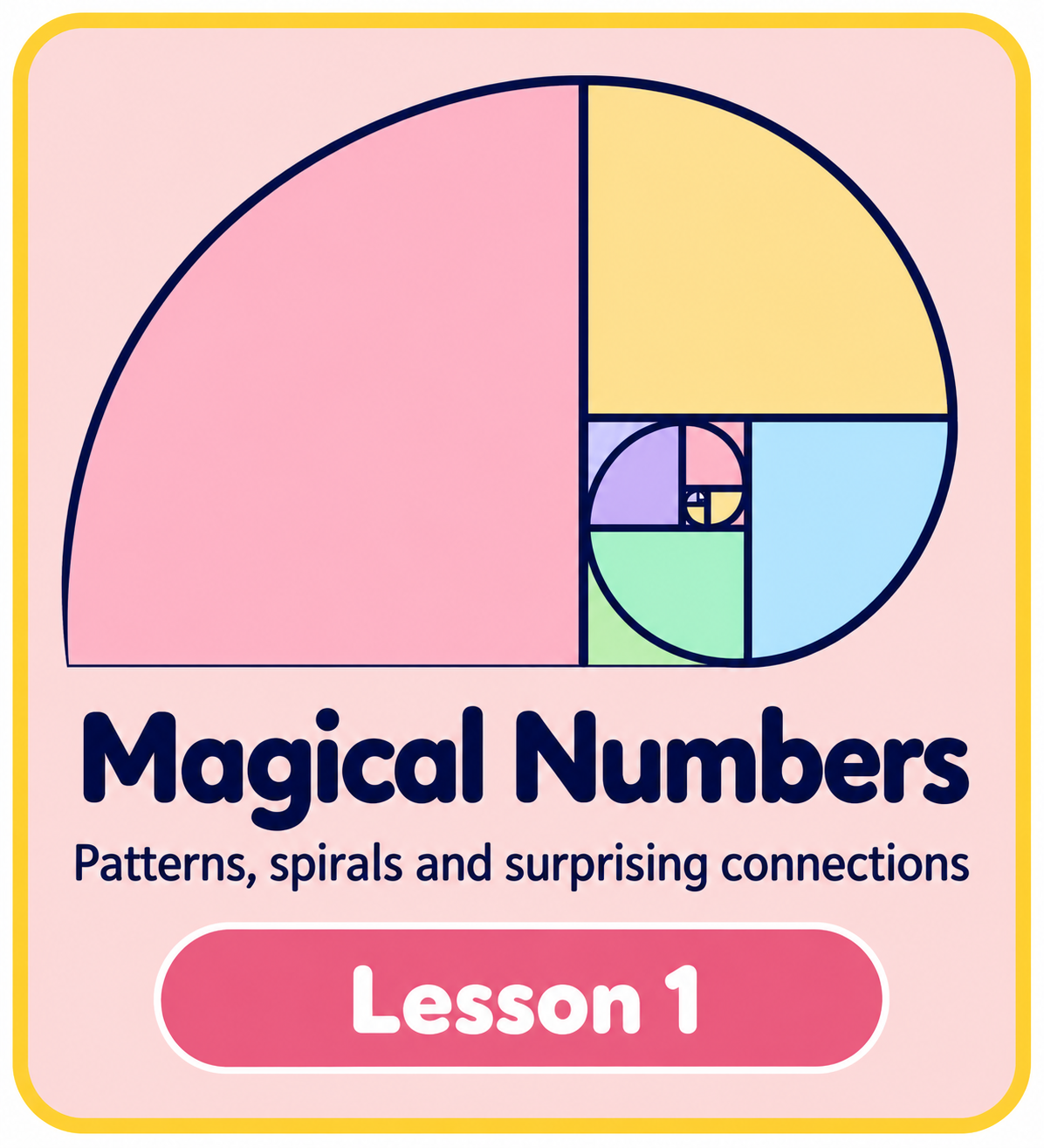
Lesson 1: The Fibonacci sequence
Download the Lesson 1 printable handout with visual explanations, worked examples, learner prompts and answers/discussion.
Get the Lesson 1 resources →What did you think?
Whether you explored this together or worked independently, we would love to hear from both learners and parents. Tell us what you enjoyed, what was confusing, or what you would like to see next.
Share your feedback
The form is short and you do not need to give your name.