Fibonacci numbers do not have to stay in a list. We can turn them into geometry.
Build a Fibonacci rectangle
Start with two 1×1 squares. Add a 2×2 square, then a 3×3 square, then 5×5, then 8×8. Each new square has side length equal to the next Fibonacci number.
The whole rectangle is 13 × 8. Every square has a Fibonacci side length.
The outside rectangle is now 13 × 8.
💡
Reveal answer
The next square is 13 × 13.
Attach it along the side of length 13. The new outer rectangle has dimensions 13 × 21.
After that, a 21 × 21 square would make a 21 × 34 rectangle. The side lengths keep moving through neighbouring Fibonacci numbers.
Because each new side length is the sum of the previous two, the pieces fit together into larger and larger rectangles.
Draw the spiral
Inside each square, draw a quarter-circle from one corner to an adjacent corner. As the squares grow and turn around the rectangle, the separate arcs join into one continuous spiral-like curve.
Watch each Fibonacci square appear, followed by its quarter-circle. Notice that the curve turns through another quarter-turn each time.
Use squared paper if you have it. This time, arrange the Fibonacci squares 1, 1, 2, 3, 5, 8 so that the construction turns the opposite way from the animation. Then draw the quarter-circles so that they join into one continuous spiral.
Step 1 — start in the two 1 × 1 squares
Draw a quarter-circle through the first 1 × 1 square, then continue with a quarter-circle through the second 1 × 1 square.
The second arc should continue smoothly from the first rather than starting a new curve.
Step 2 — continue through the 2 × 2 square
Draw the next quarter-circle using the full side length of the 2 × 2 square as the radius.
Before drawing it: predict which way the spiral has to turn.
Step 3 — repeat for 3, 5 and 8
Continue the same pattern. Each quarter-circle uses the side length of its square as its radius.
Your radii should now be 1, 1, 2, 3, 5, 8.
💡
Reveal observation
The spiral turns through a quarter-turn each time. The squares are added around the outside of the rectangle in a repeating rotation.
That is why the separate quarter-circles join into one continuous spiral-like curve.
Suppose you add squares of side 13 and then 21.
Before revealing the answer, decide: will the spiral change its basic shape, or will it keep the same turning pattern?
Reveal answer
It keeps the same quarter-turn pattern. The curve gets larger, but the construction rule stays the same.
This repeated growth is what makes the Fibonacci spiral look increasingly regular as it expands.
The familiar spiral made from quarter-circles is an approximation. As the rectangles get larger, its overall shape becomes closer to a logarithmic spiral associated with the golden ratio.
You have built squares of side 1, 1, 2, 3, 5, 8 and 13. What should the side length of the next square be, and what are the dimensions of the new outer rectangle?
💡
Reveal answer
The next side length is 21. A 13×21 Fibonacci rectangle becomes 21×34 after the new square is added.
Do spirals in nature prove anything?
You may see claims that sunflowers, pinecones, shells and galaxies are “made from Fibonacci spirals”. Some natural growth patterns do produce counts related to Fibonacci numbers, especially in plant arrangements. But many pictures online are exaggerated or fitted afterwards.
A good mathematical habit is to ask: what exactly was measured? and how close does it really have to be?
Calculate the long-side ÷ short-side ratio for the Fibonacci rectangles 2×3, 3×5, 5×8, 8×13 and 13×21. What seems to be happening?
Reveal answer
The ratios are about 1.5, 1.667, 1.6, 1.625 and 1.615. They wobble around while settling near a number close to 1.618.
That number is the subject of the next lesson.
What have we learned?
- Fibonacci squares fit together because of the addition rule.
- The famous quarter-circle construction gives a Fibonacci spiral.
- The rectangle ratios seem to approach about 1.618.
That mysterious 1.618… is the golden ratio.
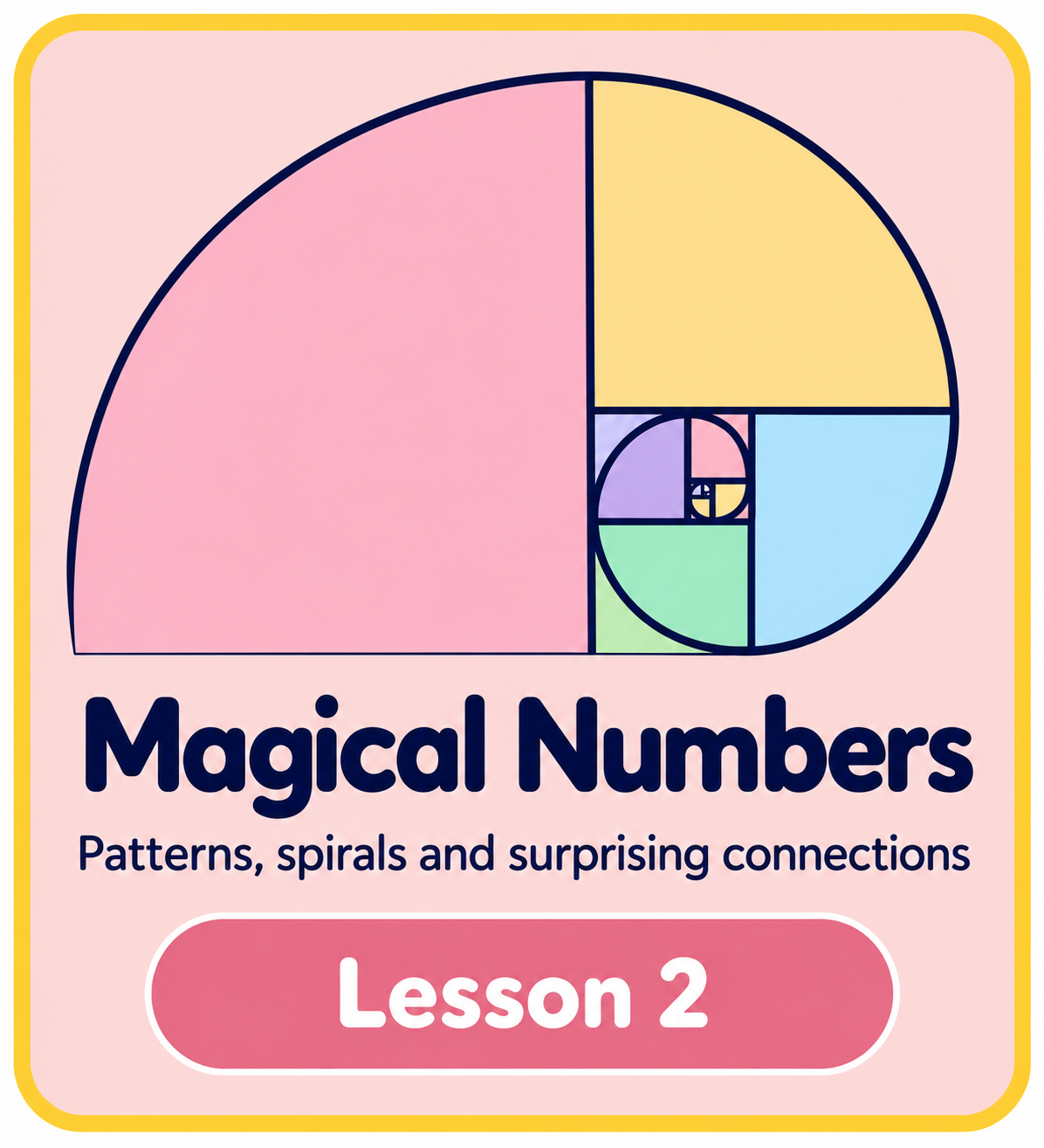
Lesson 2: Fibonacci rectangles and spirals
Download the Lesson 2 printable handout to build Fibonacci rectangles, explore the spiral construction and investigate ratios of neighbouring Fibonacci numbers.
Get the Lesson 2 resources →What did you think?
Whether you explored this together or worked independently, we would love to hear from both learners and parents. Tell us what you enjoyed, what was confusing, or what you would like to see next.
Share your feedback
The form is short and you do not need to give your name.