In the last lesson, the ratios of consecutive Fibonacci numbers kept drifting towards the same value.
1.6180339887…
This number is called the golden ratio. Mathematicians usually write it with the Greek letter φ (phi).
You do not need to know about square roots, quadratic equations or advanced rearranging to understand the main idea.
The important part is to notice the pattern: a special rectangle keeps the same proportions after a square is removed, and this leads to a special relationship involving φ. Any heavier algebra is labelled as an advanced extension and can be skipped.
A rectangle that copies itself
What are proportion and ratio?
A rectangle’s proportions describe how its long and short sides compare. We can write that comparison as a ratio: long side : short side.
The first two rectangles are different sizes but have the same proportions: each long side is twice its short side. The third has a different ratio, so it has a different shape. In general, two rectangles chosen at random will not have the same proportions.
Now let’s look at a special rectangle that does keep its proportions when a square is removed.
First look at the whole rectangle. Then remove the largest possible square and compare what is left.
The original rectangle has sides φ ≈ 1.618 and 1. After removing the 1 × 1 square, the smaller rectangle has sides 1 and φ − 1 ≈ 0.618. Here it is turned so that both rectangles lie horizontally.
≈ 0.618
Both drawings use the same scale. Since 1 ÷ 0.618 ≈ 1.618, the long-to-short ratio is the same in each. The smaller rectangle has the same proportions as the original.
For this special rectangle to keep the same shape, the original rectangle and the smaller leftover rectangle must have matching proportions. That creates a relationship involving only one unknown number: φ.
The self-copying rectangle leads to the relation
φ = 1 + 1/φ
You do not need to solve this equation yourself. The important point is that we have found a rule that depends only on φ. Mathematicians know how to solve equations of this kind, and the positive solution is the golden ratio.
Why Fibonacci ratios approach φ
Earlier we saw that ratios of neighbouring Fibonacci numbers get closer and closer to about 1.618. There is a deeper algebraic reason for this: the Fibonacci rule eventually leads to the same self-similar relationship we found for the golden rectangle.
You do not need to follow the algebra below to understand the lesson. The key idea is simply that both the Fibonacci ratios and the golden rectangle end up obeying the same rule, so the same number φ appears in both places.
Use a calculator to work out these ratios:
For each one, decide: is it above or below φ ≈ 1.618034? How far away is it?
💡
Reveal the pattern
8/5 = 1.6 — below φ.
13/8 = 1.625 — above φ.
21/13 ≈ 1.615385 — below φ.
34/21 ≈ 1.619048 — above φ.
55/34 ≈ 1.617647 — below φ.
The ratios zig-zag above and below φ while getting closer overall.
Imagine a rectangle with short side 10. You remove a 10 × 10 square. What should the long side be if the leftover rectangle is to have the same proportions as the original?
💡
Reveal answer
The long side must be 10φ ≈ 16.18.
After removing the 10 × 10 square, the leftover rectangle is about 10 × 6.18 — the same shape, rotated.
If φ² = φ + 1, simplify φ³ without using a decimal approximation.
💡
Reveal answer
φ³ = φ·φ² = φ(φ + 1) = φ² + φ = (φ + 1) + φ = 2φ + 1.
A surprising Fibonacci formula
This next formula is here as a glimpse of where the mathematics can go. You are not expected to understand or use it at this stage.
There is a direct formula for the nth Fibonacci number:
Fₙ = (φⁿ − ψⁿ)/√5, where ψ = (1 − √5)/2
This is called Binet’s formula. It is remarkable because Fibonacci numbers are whole numbers, while the formula uses square roots and irrational numbers. For now, you can simply treat it as an interesting advanced result.
Compare 13/8, 21/13, 34/21 and 55/34 with φ ≈ 1.618034. Which is closest?
Reveal answer
55/34 ≈ 1.617647, which is the closest of these four. In general the Fibonacci ratios get closer and closer to φ.
What have we learned?
- φ = (1 + √5)/2 ≈ 1.618.
- φ satisfies φ = 1 + 1/φ and φ² = φ + 1.
- Ratios of consecutive Fibonacci numbers approach φ.
- The same number links recursion, geometry and algebra.
Next we meet numbers that cannot be written as ordinary fractions at all.
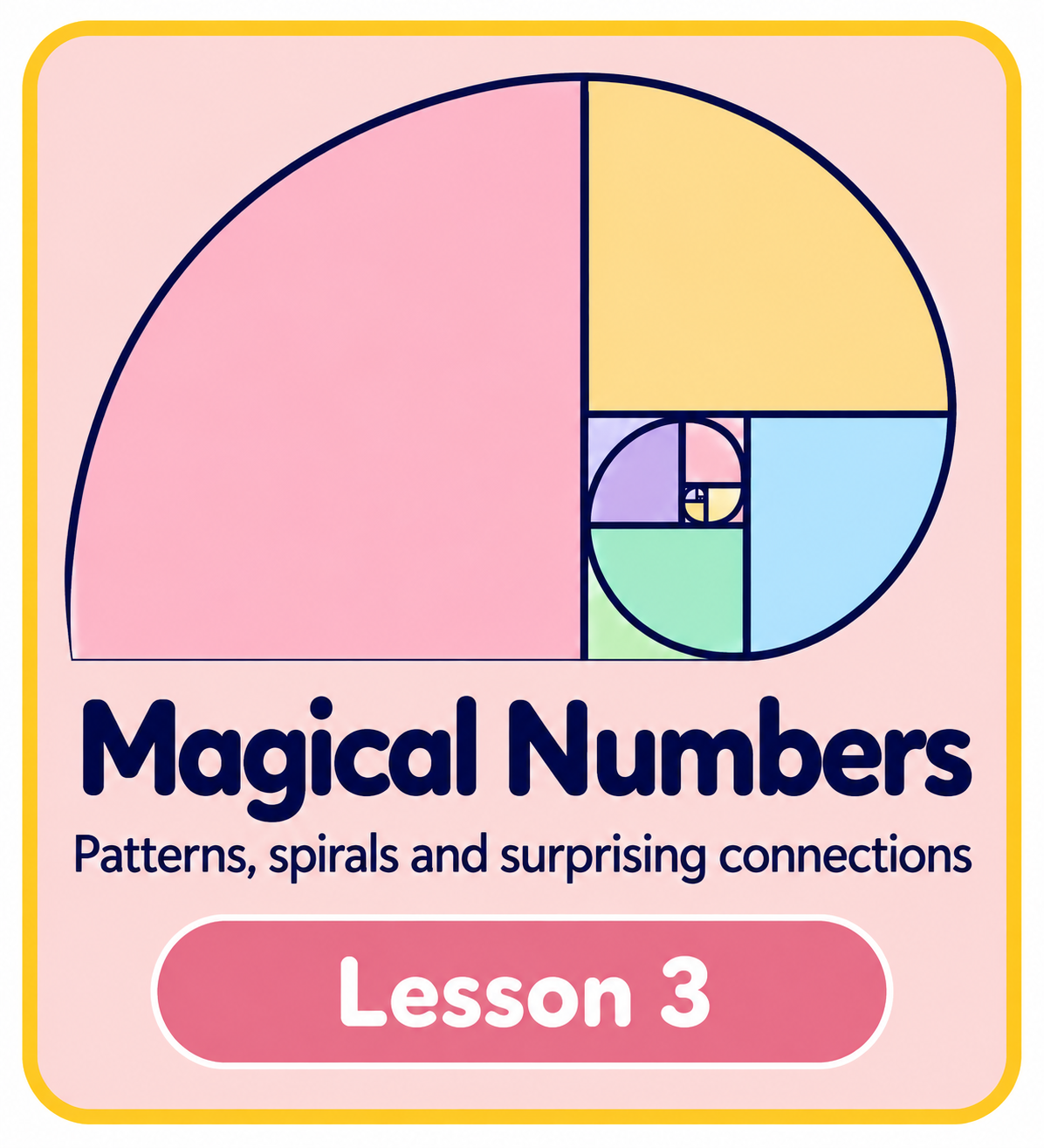
Lesson 3: The Golden Ratio
Download the Lesson 3 printable handout to explore proportion, golden rectangles, Fibonacci ratios and the relationship φ² = φ + 1.
Get the Lesson 3 resources →What did you think?
Whether you explored this together or worked independently, we would love to hear from both learners and parents. Tell us what you enjoyed, what was confusing, or what you would like to see next.
Share your feedback
The form is short and you do not need to give your name.