Description
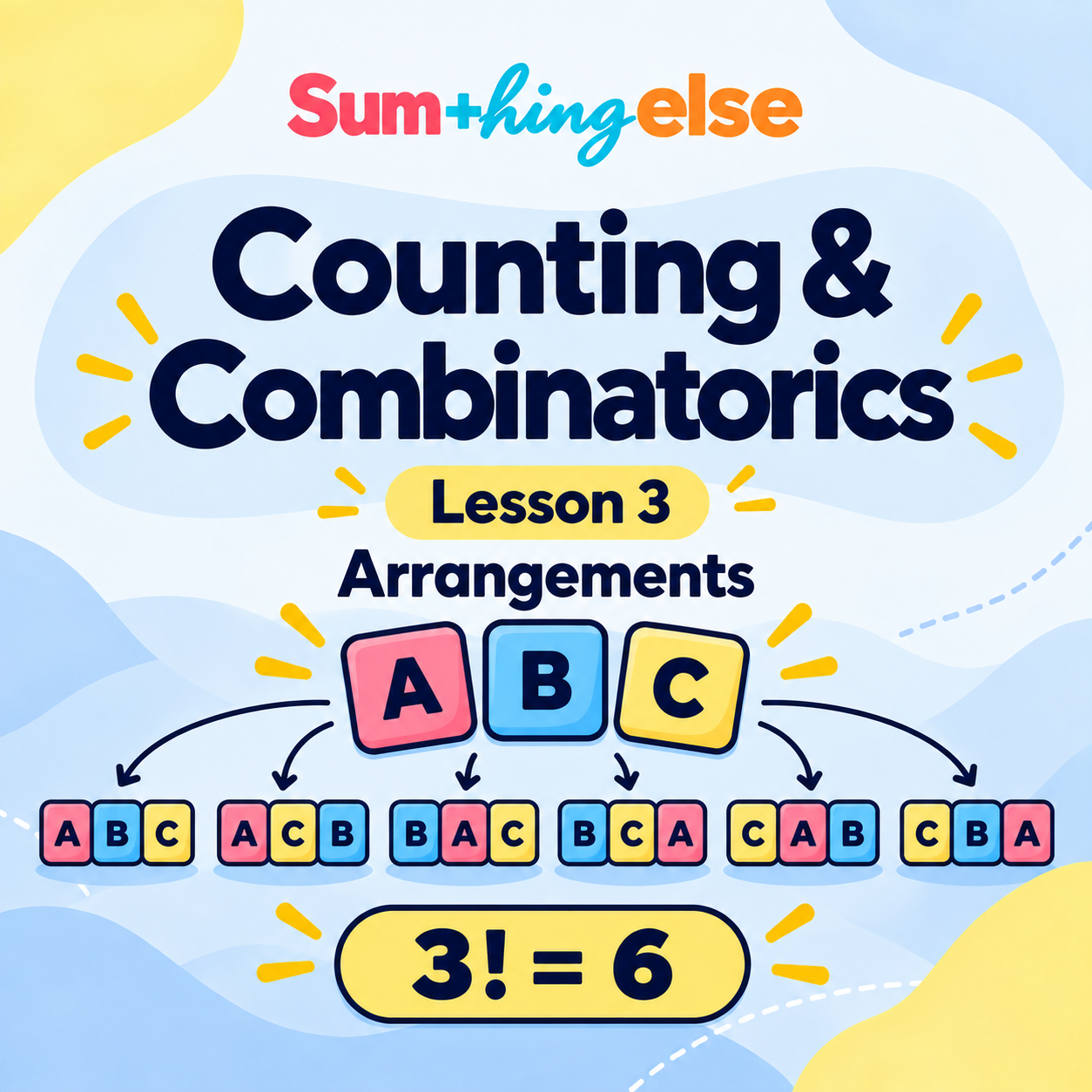
How many different orders can the same objects make?
In Lesson 3 of Counting & Combinatorics, learners explore arrangements by placing books, people and letters in different orders. They discover how the multiplication principle leads naturally to factorials.
The lesson then develops the idea through fixed positions, restricted positions and problems where two objects must stay together.
This lesson includes
- a clear introduction to arrangements and why order matters;
- worked examples using books, people and letters;
- factorial notation and the rule for arranging n different objects;
- problems with fixed and restricted positions;
- the block method for objects that must stay together;
- a challenge on keeping two friends together;
- answers and discussion;
- supplementary exercises for extra practice and revision.
Suitable for learners aged 10 and over. Familiarity with the multiplication principle from Lesson 2 is helpful.
☕ Free to download
This resource is completely free. If you find it useful and would like to
support the creation of more free mathematics resources, you can
support Sumthing Else on Ko-fi
.
This is Lesson 3 of the 6-part Beyond Curriculum: Counting & Combinatorics course.