Description
Why does Pascal’s triangle appear whenever we count combinations?
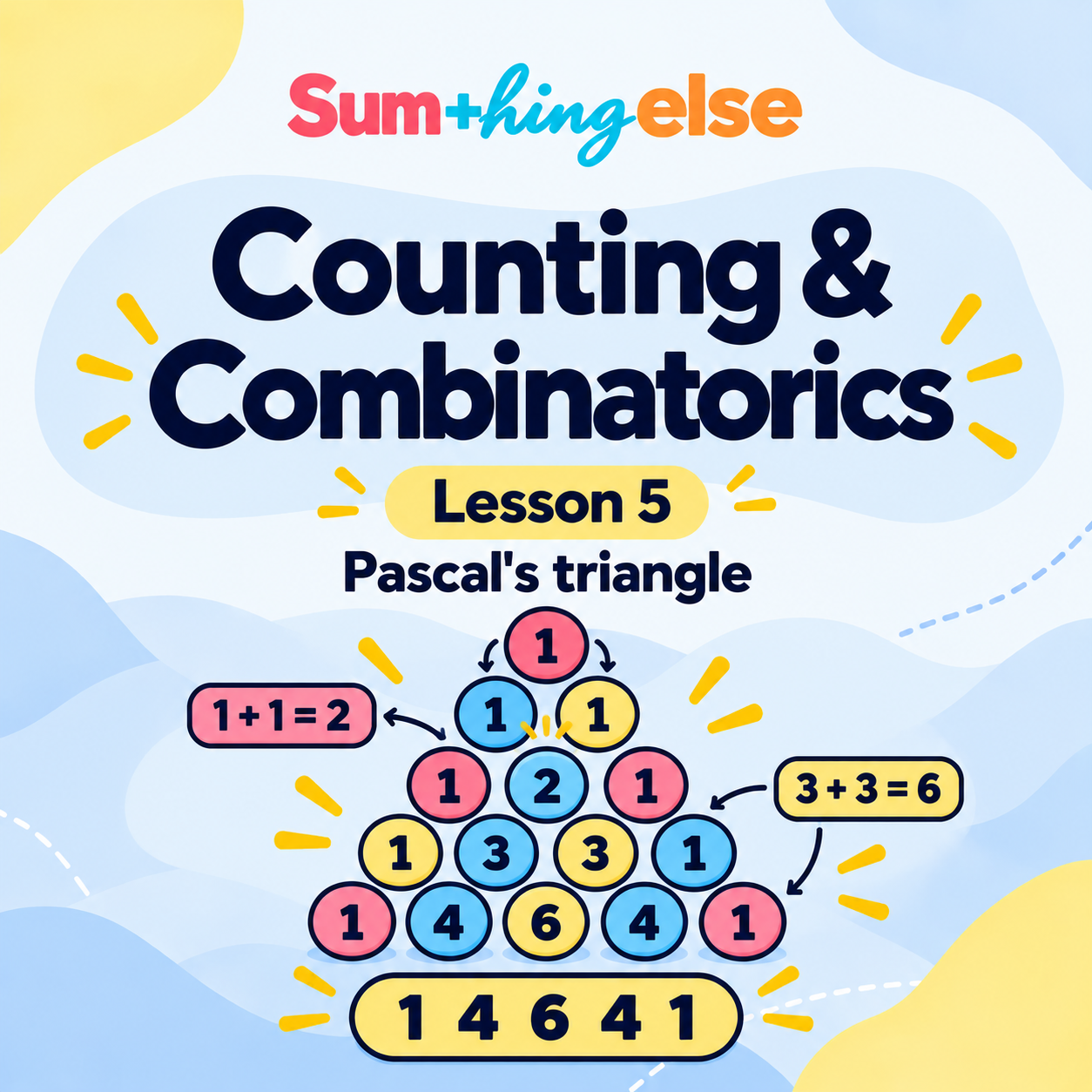
In Lesson 5 of Counting & Combinatorics, learners build Pascal’s triangle row by row and investigate the patterns hidden inside it. They then connect each row with the numbers of ways to choose different-sized groups.
The lesson explains why neighbouring entries add together, explores symmetry and row sums, and shows how Pascal’s triangle can answer combination questions without starting again from scratch.
This lesson includes
- building and continuing Pascal’s triangle;
- the rule that each inside entry is the sum of the two above it;
- the connection between Pascal’s triangle and combinations;
- committee and team-selection problems;
- an explanation of the Pascal recurrence using two cases;
- symmetry and other patterns in the triangle;
- answers and discussion;
- supplementary exercises for extra practice and revision.
Suitable for learners aged 10 and over. Familiarity with combinations from Lesson 4 is recommended.
☕ Free to download
This resource is completely free. If you find it useful and would like to
support the creation of more free mathematics resources, you can
support Sumthing Else on Ko-fi
.
This is Lesson 5 of the 6-part Beyond Curriculum: Counting & Combinatorics course.