
Maths revision is something I used to think happens organically, as the fundamental concepts we learn early on are used over and over again. And for many things, that works. Addition, multiplication and other everyday skills keep resurfacing. But I gradually realised that this isn’t true of everything we learn. Some methods can disappear from view for weeks or months.
This is a trap I have fallen into more than once while teaching maths to my own children. You introduce a new idea. They understand it almost immediately. You demonstrate an example; they can copy the method, then solve one independently. You make the questions progressively harder and they continue getting them right. Something that might occupy several weeks of classroom lessons appears to have been mastered in an afternoon.
Excellent. As a proud home-educating parent, you let them go and play, feeling that you have done your job for the day, the week and possibly the rest of their mathematical education.
Except that two months later you put the same idea in front of them — and they make mistakes, get confused, or seem to have forgotten how to start.
I confused understanding with retaining
I have seen this with long multiplication and division, BODMAS, adding and multiplying fractions, and other topics that seemed completely secure at the time.
That led me to realise that I had confused being able to do something very well today with having learnt it permanently.
A child who learns quickly may need very little initial repetition. But that does not necessarily mean they need less long-term practice. If we never come back to an idea, a skill that once looked remarkably strong can fade.
So what do we actually do?
In theory, I could maintain a carefully calculated revision schedule for every topic we cover. In reality, that could become another full-time job.
I try to build maths revision into our normal week instead. Mondays are for warm-ups. We bring back a handful of things we have learned quite recently. Fridays are for a random revision topic: something we haven’t touched for a while.
There is room to make this more systematic. Careful scheduling — and increasingly AI — could help keep track of what a child has studied and what hasn’t appeared recently. But I don’t think we should let the perfect system get in the way of a very simple question:
What haven’t we done in a while?
Pick something and bring it back. That is already better than allowing a topic that looked completely secure in March to disappear until September.
This is also the idea behind our Practice Lab — Times Tables Recall. Rather than treating times tables as something to learn once and then leave behind, it keeps bringing them back into view, helping knowledge become durable rather than merely familiar for a few days.
We’re also working on a growing collection of random and unusual revision questions for “same old” topics. The idea is not to give children another page of near-identical exercises, but to bring familiar mathematics back in slightly unexpected contexts. A topic may be old; the question doesn’t have to be.
Maths revision doesn’t have to mean another worksheet
There is another problem. If the child understood the topic easily the first time, another page of almost identical calculations is boring.
Instead, I increasingly prefer one wordy, catchy problem that gives us a reason to use the old mathematics.
How many people could actually fit inside our house?
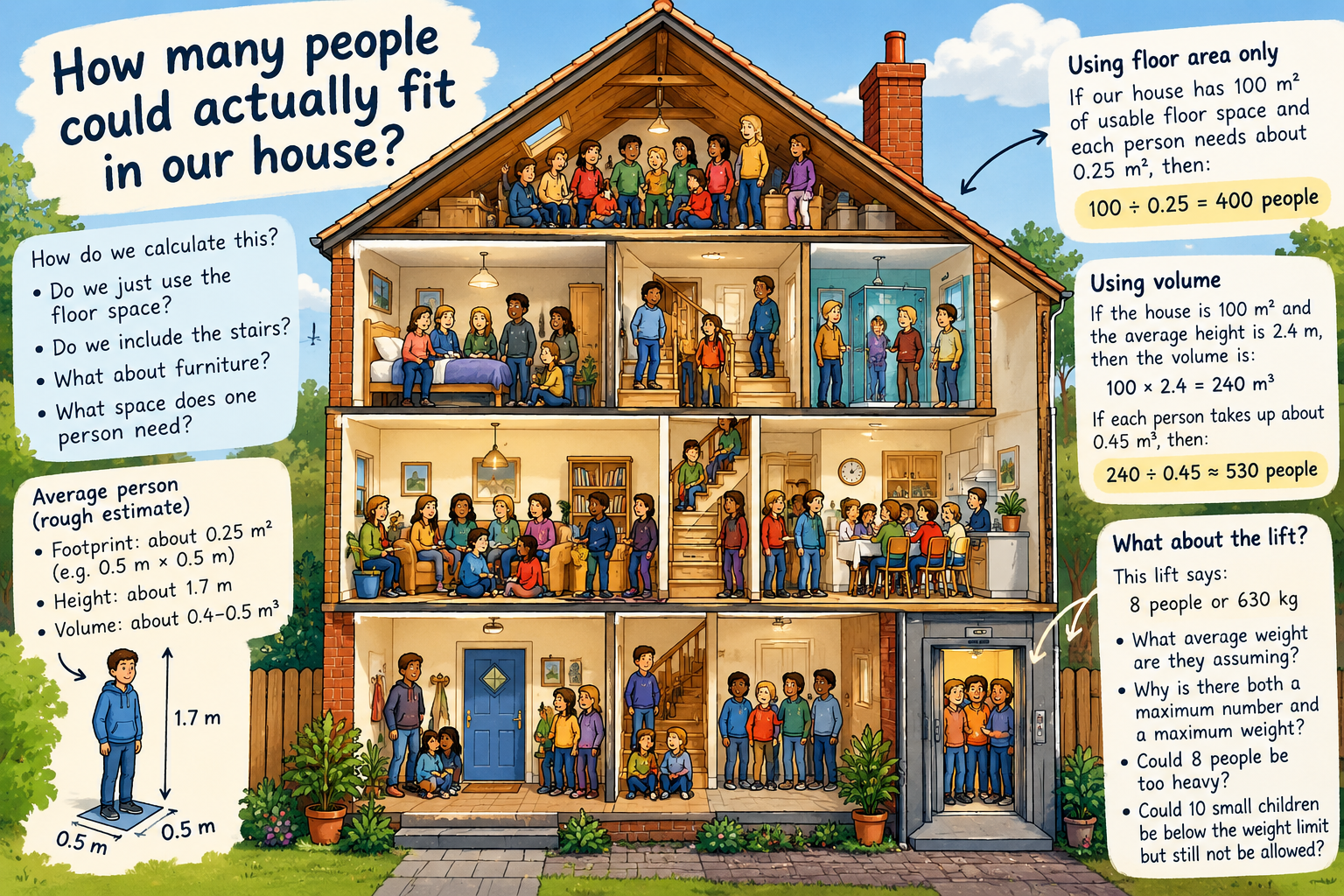
Immediately there are decisions to make. Do we use only the available floor area? How much space does one person occupy? Do we include furniture? Or do we interpret “inside” literally and pack the entire volume? In that case, what is the volume of our house — and what is the volume of an average person?
Suddenly we are estimating, measuring, multiplying, dividing, working with area or volume, converting units and arguing about whether our assumptions are sensible.
Then there are lifts. A lift might specify a maximum number of people and a maximum weight. How are those numbers calculated? What average weight is being assumed? Could eight people exceed the weight limit?
One slightly ridiculous question can resurrect a surprising amount of old mathematics without announcing: Today we are revising multiplication.
And because the problem doesn’t tell the child which operation to perform, they have to decide what mathematics might actually help.
A warning from home education
Of course, home education has a remarkable tendency to turn one interesting question into an entirely different day’s education.
Before long, “How many people fit in our house?” can become a discussion about architecture, lift engineering, crowd density, human anatomy or whether it would be possible to fill the house with guinea pigs instead.
Sometimes those diversions are exactly what we want. But if today’s purpose is to retrieve some mathematics that hasn’t been used for a while, it is worth keeping an eye on the ball. Write down the fascinating side question for another day and come back to:
Right. So how are we actually going to calculate this?
Move forward — but leave paths back
I don’t want old maths revision to slow down a child who is ready for new mathematics. Quite the opposite.
Let them move forward. Stop the repetitive practice when it has clearly stopped being useful. Explore harder and more interesting ideas.
But leave little paths leading back to the mathematics they have already learned.
Not twenty questions at once. Perhaps just one interesting question on Monday, an old topic on Friday, and another unexpected encounter a few weeks later.
The goal isn’t for a child to complete twenty fraction calculations on the afternoon we teach fractions. The goal is for fractions to become part of the mathematical equipment they can still reach for a year later.
Further reading
The ideas in this post connect with research on retrieval practice and distributed (spaced) practice: bringing previously learned material back to mind and revisiting learning over time.
For a detailed review of the evidence, see Dunlosky et al. (2013), Improving Students’ Learning With Effective Learning Techniques: Promising Directions From Cognitive and Educational Psychology. The review identifies practice testing and distributed practice as particularly well-supported techniques for improving learning and retention.
For a shorter, practical example in mathematics, the Education Endowment Foundation’s Retrieval practice: a game of ‘hide and seek’ looks at how mathematical games and varied activities can provide retrieval practice without simply giving children another quiz.