Introducing fractions through real things
Before fraction notation means anything, learners need repeated experiences of making, sharing, measuring and breaking wholes into equal parts. This stage is not a warm-up to “real maths”: it is where the ideas are built.
Why spend time here?
Young learners in particular need to meet fractions before they meet fraction rules. They need to see that a fraction describes a relationship between a part and a whole, and that the whole can change from one situation to another.
A child who has poured half a jug, shared a pancake between two people, broken a chocolate bar into equal pieces and rebuilt a whole from wooden fraction pieces already has many of the ideas that later appear as symbols. When the notation arrives, it has something to attach to.
This kind of play also starts the next conversations naturally. “Are these pieces equal?” leads towards denominators. “Is two quarters the same as one half?” leads towards equivalent fractions. “What if we put these two pieces together?” leads towards addition. “How many halves fit in two wholes?” leads towards division. Do not hurry past the stage that makes those later ideas feel inevitable.
Start in the kitchen: measure, pour and compare
Cooking gives fractions a purpose. The aim is not to turn every recipe into a worksheet, but to notice the language that is already there.
Use a measuring cup or scoop. Fill one cup, then make a half cup and two half cups. Compare them side by side. Try quarters if the container makes them easy to see.
Transparent jugs make the whole visible. Mark halfway, then ask what would happen if the same amount were split into four equal levels instead.
“What is the whole here?” “How could we make two equal parts?” “Would these still be halves if one part were bigger?” “Can two quarters fill the same space as one half?”
Share food: pizza, cake and pancakes
Round food is useful because cutting feels natural and mistakes are visible. Start with sharing rather than naming.
Useful language: equal parts, whole, half, quarter, same amount, bigger whole, smaller whole. Keep the language attached to what the learner can see and touch.
Break and rebuild: chocolate and other segmented objects
A chocolate bar, snap-together construction toy or strip of card is especially useful because the equal pieces are already marked.
Start by agreeing what one whole is. Break the whole into equal pieces and count them. Take one piece, then two, then enough pieces to rebuild the whole. Ask the learner to describe the amount before introducing notation.
This is a good place to notice that the denominator describes the size of the pieces. If the bar is divided into 8 equal pieces, each piece is one eighth. If it is divided into 4 equal pieces, each piece is one quarter. More pieces means smaller pieces when the whole stays the same.
Prepare a small fraction-props box
Having a few familiar objects ready means you can return to the same visual model whenever a later topic becomes confusing. They do not need to be perfect. In fact, self-made props are often the most useful, because making them forces everyone to pay attention to the details.
While drawing, folding, cutting and colouring, you naturally talk about where the whole begins and ends, whether the parts are really equal, why one denominator makes smaller pieces than another, and which fractions line up. The conversation happens while the maths is being built.
Start with several matching circles cut from coloured card. Divide them into halves, thirds, quarters, sixths and eighths. Separate circles make it easy to place one fraction on top of another and compare them directly.
Equal rectangles or strips are especially flexible. They are easy to divide accurately into fifths, sevenths and larger denominators, and the pieces line up clearly for comparison.
Wooden fraction circles or bars are durable and quick to use. They are useful alongside homemade pieces, not instead of them. Keep them available rather than treating them as a temporary crutch.
Buttons, beads, grapes or blocks help when the whole is a collection rather than one shape. They make “one quarter of 12” visibly different from “one quarter of a pizza”.
A circle naturally suggests halves, quarters and some other familiar partitions, but it becomes awkward to divide accurately into fifths, sevenths or larger numbers. Rectangles and strips are much better for those denominators. Using both helps prevent the idea that fractions “belong” to one particular shape.
Homemade fraction pieces: imperfect is fine
These are the sort of props we mean. They are not shop-perfect, and that is part of their value. The act of making them draws attention to the mathematics: where to place each division, whether the parts are equal, which colours should match, and how one fraction relates to another.
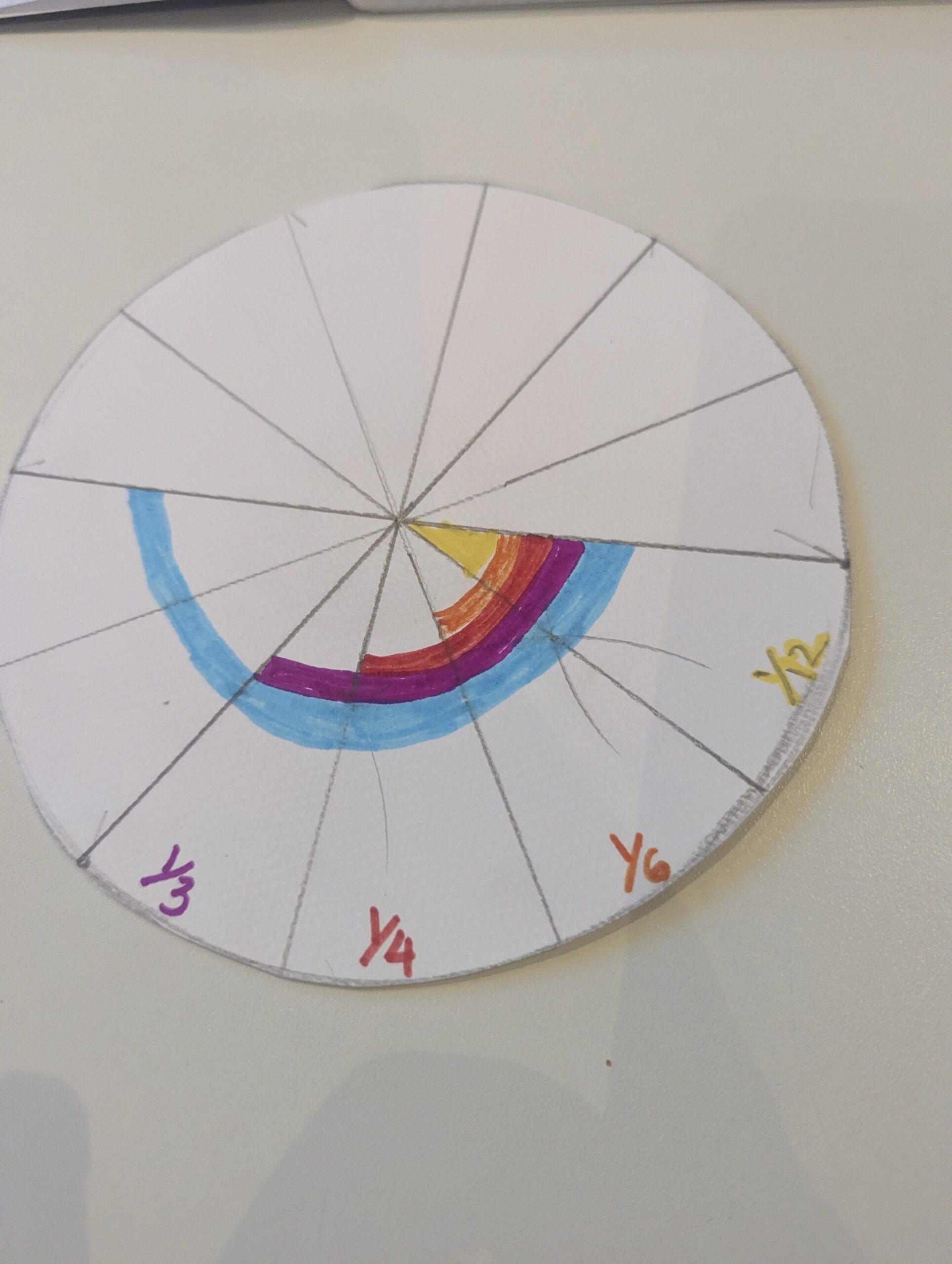
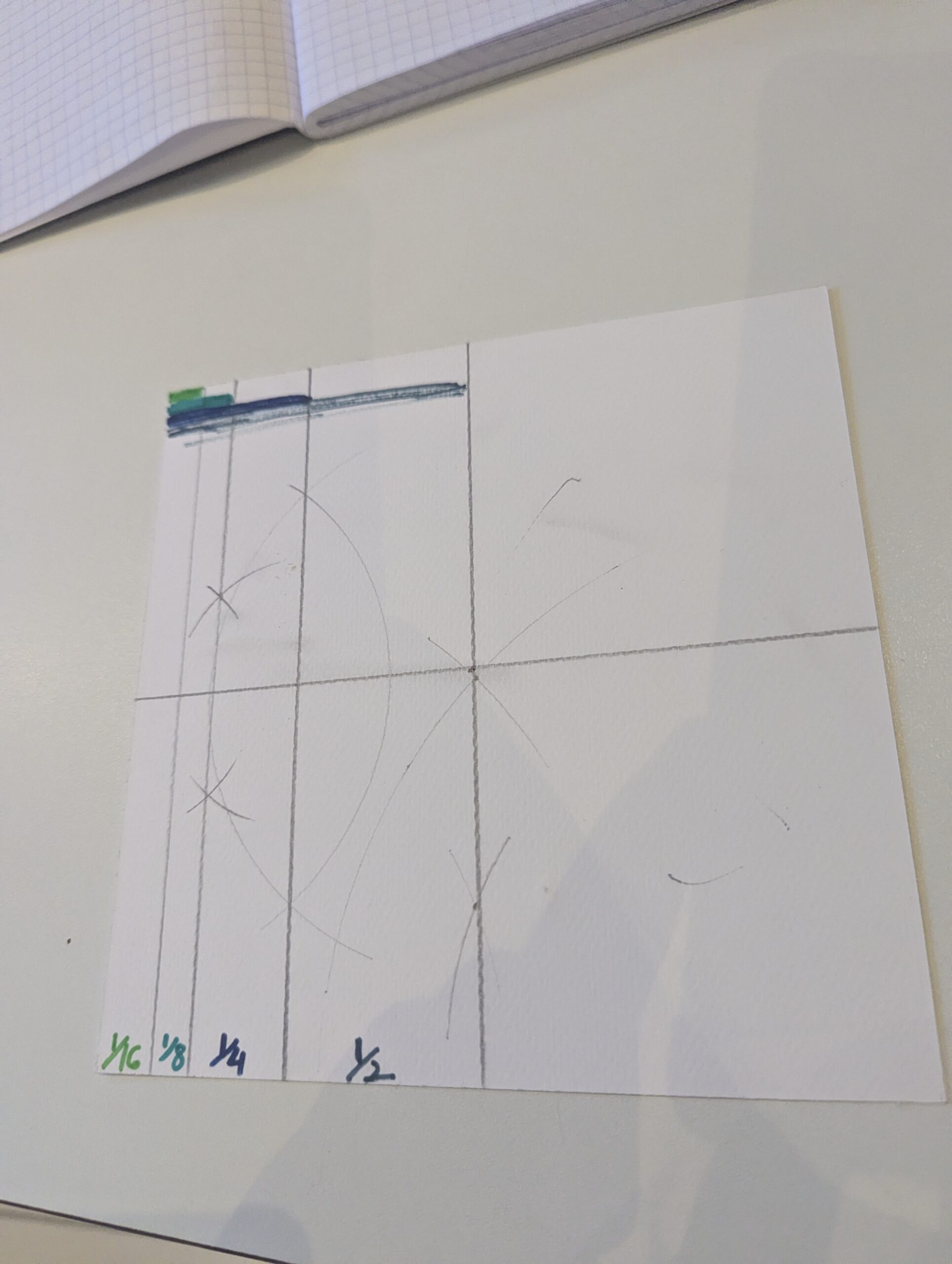
An all-in-one reference circle is useful because it keeps many relationships together in one place. But making multiple circles from coloured card gives a different experience: each fraction becomes a physical object that can be moved, compared and combined. The same is true of rectangles and strips.
When a child helps make the pieces, ask questions as you go: “How do we know these are equal?” “Will two of these cover one half?” “Why is one seventh smaller than one fifth?” “Could we divide this circle neatly into fifths?” Those conversations are often more valuable than the finished prop.
Keep the pieces available for later lessons. They can become a familiar checking tool for equivalent fractions, addition, subtraction and multiplication rather than something that disappears once Lesson 1 is over.
Mathematical links to notice — without forcing them
Fraction play opens many doors. You do not need to turn each one into a formal lesson immediately; simply notice the connection when it appears.
Half a litre, quarter of a cup, halfway along a strip.
One whole shared equally between 2, 3 or 4 people.
Two quarters cover the same amount as one half.
Put fraction pieces together or physically take some away.
Three lots of one quarter, or half of a half.
Which is larger: one half or one quarter? Does the answer depend on using the same whole?
A clock face makes quarters and halves part of everyday language: quarter past, half past and quarter to. It is a useful bridge between fractions, angles and telling the time.
Half a pound, quarter of a pound, half a pint and quarter of a mile show fractions embedded in measurement language. Use familiar examples rather than treating the units themselves as the lesson.
Half of £1 is 50p; a quarter is 25p. Half of $1 is 50¢; a quarter is 25¢. Coins make fractions feel concrete and give children a familiar reason to care about the arithmetic.
What not to rush
Do not make correct vocabulary the price of joining the conversation. A learner may first say “this bit” or “two of these pieces”. Give the mathematical word alongside their idea rather than interrupting the idea.
Do not move immediately to numerator-and-denominator rules because they can count shaded boxes. Check that they understand equal parts and can identify the whole in different settings.
And do not remove concrete materials as soon as they answer correctly. The goal is not to prove that they can work without support; it is to build a network of meanings they can return to when the mathematics becomes more abstract.
Keep the pace gentle
Do not rush on simply because one answer is correct. Stay with the idea of the whole and equal parts until the learner can explain it in their own words. Introduce new ideas and language gradually, rather than bringing in several terms or rules together.
A few examples are enough
Choose one or two clear examples and explore them properly. Add a third only if it helps clarify a point; too many different shapes, objects or questions at once can obscure the central idea.
When the concept starts to feel familiar, offer a new example as a gentle challenge to see whether the learner can use the idea in another setting. If it causes confusion, return to the familiar example. Understanding matters more than the number of examples completed.
When to move into the learner lesson
The learner does not need perfect language or instant recall. It is enough that they can take a whole, split or share it into equal parts, recognise some familiar fractions, and talk about what the pieces mean.
Then use the learner page to make the pictures and notation more explicit. Keep the real props beside you. If the symbols stop making sense, move back to the objects rather than pushing through.
Open Lesson 1: Visualise fractions →