In the last lesson, we learned how to organise possibilities so that nothing is missed and nothing is counted twice.
Now we are going to discover a shortcut that lets us count many possibilities without listing them all.
From a tree to multiplication
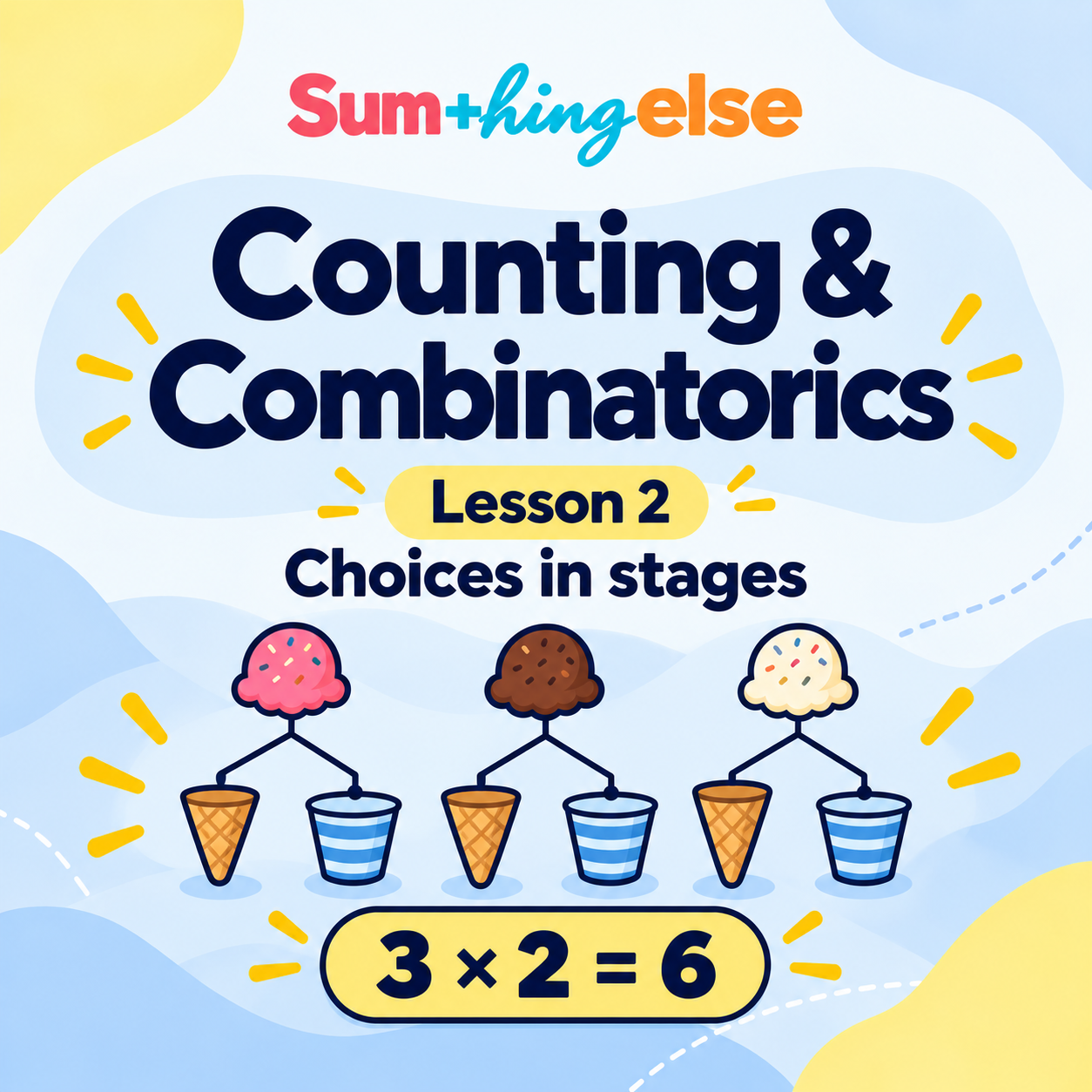
In Lesson 1, we counted outfits made from 3 T-shirts and 2 pairs of trousers.
There are 3 choices at the first stage. From each of those, there are 2 choices at the second stage.
So instead of counting the six endpoints one by one, we can write:
That multiplication is not a coincidence.
If there are a choices at one stage and, for each of them, b choices at the next stage, then there are a × b possible outcomes.
Use a tree, a table/list, or multiplication. If you can, check one problem a second way.
Ice cream · 4 flavours and 3 cones
How many different flavour-and-cone choices are possible?
Show answer
4 × 3 = 12.
Game character · 3 hairstyles, 4 shirts, 2 shoes
How many different characters can be built?
Show answer
3 × 4 × 2 = 24.
2. Does the order of the stages matter?
We can organise the same possibilities in different orders. The total does not change.
3. What if the same choices are available again?
Sometimes making one choice does not remove anything. Each new stage starts again with the full set of possibilities.
Roll the die. After each roll, notice how many outcomes are still available for the next one.
6 choices are available before the first roll.
Without JavaScript: each roll always has 6 possible outcomes, so three rolls give 6 × 6 × 6 = 216.
4. What if a choice is used up?
Now change just one rule: once a choice has been used, it cannot be used again.
Pick any tile. You cannot use it again. Continue until you have made three choices.
4 choices
3 choices
2 choices
Without JavaScript: once one of 4 choices is used, 3 remain; then 2 remain. So 4 × 3 × 2 = 24.
Repeated roll: 6, 6, 6 — the choices reset.
No repetition: 4, 3, 2 — the pool shrinks.
Before calculating, identify the structure: ordinary stages, reordered stages, choices that reset, or choices that shrink.
1 · A café has 3 sandwiches and 5 drinks. How many sandwich-and-drink combinations?
Ordinary stages: 3 × 5 = 15.
You could draw 3 first branches, each with 5 endings.
2 · Count the same café choices starting with drinks instead.
5 × 3 = 15.
The organisation changed, but the outcomes did not: 3 × 5 = 5 × 3.
3 · A spinner has 4 equal labelled sectors and is spun three times.
The choices reset: every spin still has 4 possible outcomes.
4 × 4 × 4 = 64
4 · Choose 3 different cards from 6, one after another, without putting them back.
The choices shrink: 6 choices, then 5, then 4.
6 × 5 × 4 = 120
5 · Which is different: rolling a die twice, or choosing two different objects from five?
Rolling: 6 × 6 because the choices reset.
Choosing without repetition: 5 × 4 because one option is used up.
The key question is whether an earlier choice changes what remains available.
A box contains some yellow balls, some blue balls and some red balls.
You make a selection by choosing one yellow ball, one blue ball and one red ball.
There are exactly 24 different ways to make such a selection.
💡
Reveal answer
We need three positive whole numbers whose product is 24.
Ignoring colour order for a moment:
Because yellow, blue and red are different colours, swapping these numbers between colours gives further configurations.
There are 9 balls altogether. What can you now say about the three numbers?
Reveal answer
We need the three numbers to have product 24 and sum 9.
2, 3, 4
So there must be 2 of one colour, 3 of another and 4 of the third.
There are more red balls than blue balls, and more blue balls than yellow balls. How many of each colour are there?
Reveal answer
2 yellow, 3 blue and 4 red.
The multiplication shortcut works immediately when every choice at one stage has the same number of choices after it. But real counting problems are often less tidy.
Draw one card, then make a second choice.
If the card is red, roll a die. If the card is black, toss a coin.
💡
Reveal answer
The red branch gives 6 outcomes. The black branch gives 2.
6 + 2 = 8
Here we add separate branches. The multiplication principle cannot be used as one single product because the number of later choices depends on the first choice.
Make a 3-character code using A, B, C, 1, 2.
The first character must be a letter.
Digits may not repeat.
Letters may repeat.
Work stage by stage. How many choices are available at each position?
Position 1
3 choices: A, B or C.
Position 2
5 choices. No digit has yet been used, so A, B, C, 1 or 2 are all possible.
Position 3
This now depends on position 2. If position 2 was a letter, there are 5 choices. If it was a digit, only 4 remain because that digit cannot repeat.
💡
Reveal a counting route
For each of the 3 possible first letters, split the second character into two cases.
3 choices for position 2, then 5 choices for position 3.
2 choices for position 2, then 4 choices for position 3.
So after fixing the first letter there are 15 + 8 = 23 possibilities.
3 × 23 = 69
There are 69 valid codes.
A café offers 4 types of sandwich and 3 types of drink.
Choose one sandwich. You can have it on its own, or add one drink.
4
4 × 3
💡
Reveal answer
Sandwich only: 4 possibilities.
Sandwich and drink: 4 × 3 = 12 possibilities.
4 + 12 = 16
There are 16 different orders.
What have we learned?
Counting in stages is really about tracking how many choices are available at each step.
In simpler problems, every branch behaves the same way and one product counts everything. In harder problems, later choices may depend on earlier ones, so we may need to split the problem into cases and add the separate totals.
Download the printable handout, exercises and answers for Choices in stages.
Find the resources →Next: Arrangements
What happens when we arrange several different objects in order?
Why do the numbers 1, 2, 6, 24, 120, … keep appearing?
That leads us to factorials and permutations.
What did you think?
Whether you explored this together or worked independently, we would love to hear from both learners and parents. Tell us what you enjoyed, what was confusing, or what you would like to see next.
Share your feedback
The form is short and you do not need to give your name.