
Shrink the problem
A good learning strategy is to reduce a difficult problem to a more familiar one. Multiplication facts are no exception.
This is our first multiplication strategy: turn a less familiar fact into a fact you already understand better. This will not be the only strategy we use, but it is a very powerful one.
Optional reminder: 0s, 1s and 10s
Multiply by 0: the answer is always 0.
Multiply by 1: the number stays the same.
Multiply by 10: this is often one of the easiest tables to recognise and use quickly.
5s
You can think of 5s in two useful ways:
- count in 5s
- multiply by 10 and divide by 2
Example: 5 × 8 = 40 because 10 × 8 = 80, and half of 80 is 40.
2s, 4s and 8s
These are doubling facts:
- ×2 means double
- ×4 means double, then double again
- ×8 means double three times
Example: 8 × 3 = 24 because 3 → 6 → 12 → 24.
What is left?
Once we feel comfortable with 0s, 1s, 10s, 5s, 2s, 4s and 8s, the list starts to shrink a lot.
We are mostly left thinking about 3s, 6s, 9s and 7s.
Can you see how to get 6s and 9s from things you already know?
Reveal one possible answer
6s can often be built from 3s by doubling.
For example, if you know 3 × 7 = 21, then 6 × 7 = 42.
9s can be thought of in more than one useful way.
- 9 = 10 − 1, so 9 × 7 = 10 × 7 − 7 = 70 − 7 = 63
- 9 = 3 + 3 + 3, so 9 × 7 is also three lots of 3 × 7
If 3 × 7 = 21, then 9 × 7 = 21 + 21 + 21 = 63.
Watch the table shrink
This animation gradually removes facts that are easy, duplicated, or can be built from other facts. The final picture is much smaller and much less intimidating than the full table.
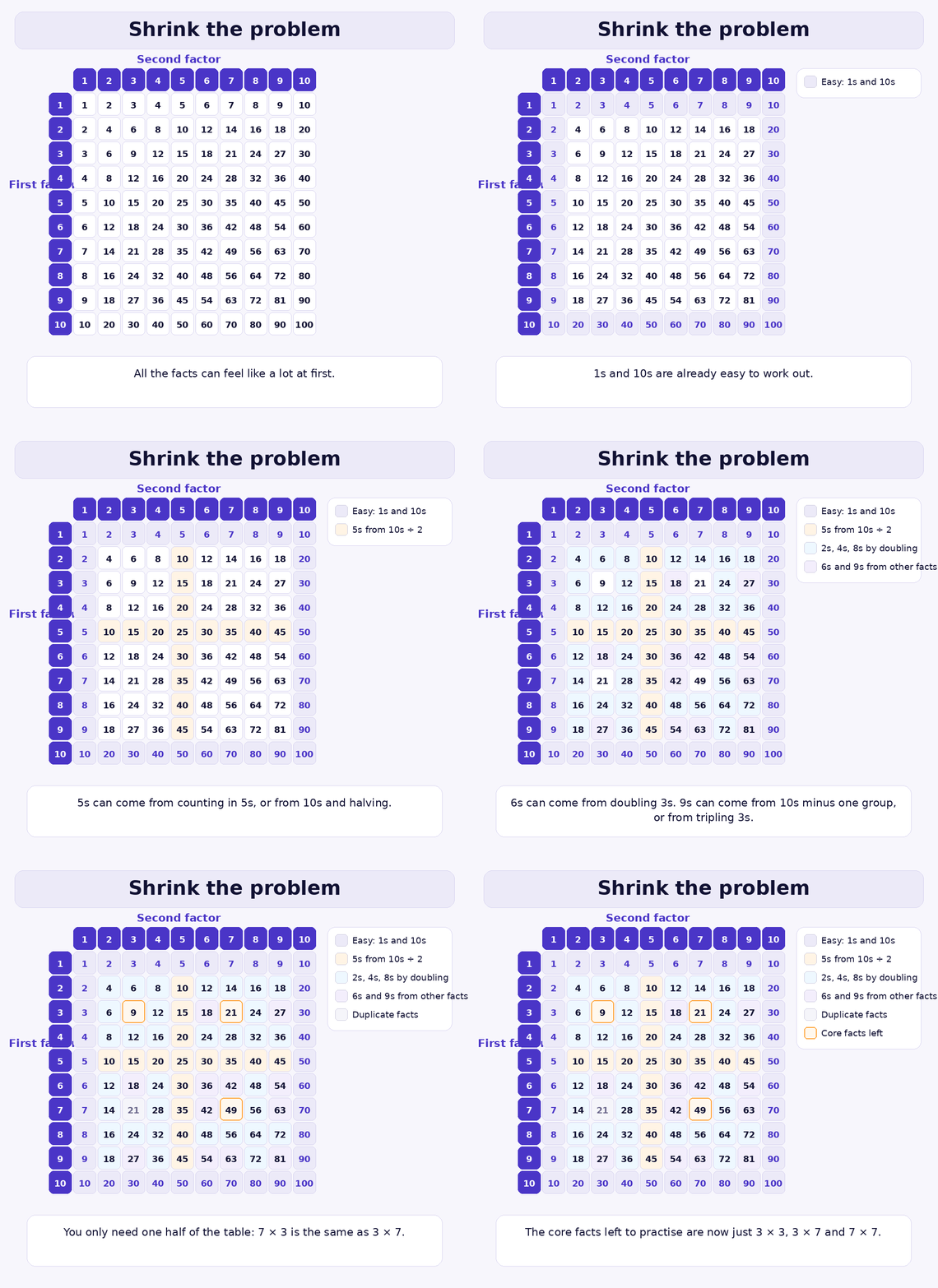
What should this feel like?
At first, times tables can look like a giant wall of unrelated facts. After shrinking the problem, that wall gets much smaller.
You do not need to treat every multiplication fact as a completely new memory job.
Many facts come from patterns, shortcuts, and facts you already know.