In the last lesson, we learned to count choices that happen in stages by multiplying the number of choices at each stage.

Now we will use exactly the same idea to count arrangements — different orders of the same objects.
What counts as a different arrangement?
In an arrangement, changing the order creates a new result.
These are different because the objects occupy different positions.
Three pigeons on a line
Suppose three different pigeons — a grey pigeon, a white spotted pigeon and a brown pigeon — are sitting on a line.
How many different orders can the three pigeons sit in?
💡
Reveal answer
Here are all the possible orders:


We fill the positions one at a time. Each time a pigeon is used, there are fewer pigeons left to choose from.
We can list every arrangement when there are only three pigeons. For larger problems, counting the choices for each position is much quicker.
We could draw or list all six orders, but we do not need to. Counting the choices for each position gives the answer directly.
3 × 2 × 1 = 6
For n different objects, there are n choices for the first position, then n−1 choices, then n−2 choices, and so on until only one object remains.
Choose a ball for each position. Once you use a ball, it cannot be chosen again. Watch how the number of choices decreases.
How shouting in mathematics can have dramatic consequences…
In ordinary writing, an exclamation mark usually means excitement:

But in mathematics, that tiny symbol changes the number completely.
We read 5! as “five factorial”.
| Expression | Value |
|---|---|
| 1! | 1 |
| 2! | 2 |
| 3! | 6 |
| 4! | 24 |
| 5! | 120 |
| 10! | 3,628,800 |
So how large do you think 1,000,000! is?
Bigger than a billion? Bigger than a googol? How many digits might it have?
Reveal
1,000,000! has 5,565,709 digits.
Mathematicians define 0! = 1. One way to think about this is that there is exactly one way to arrange no objects: the empty arrangement.
The factorial symbol is just a compact way to write the descending product that comes from the multiplication principle.
Five runners reach the finish line. There are no ties.
💡
Reveal answer
5! = 120
There are 120 possible finishing orders.
Factorials can grow astonishingly quickly, but that does not mean every arrangement problem leads to a huge number. Restrictions can remove possibilities, and symmetry can mean that several arrangements should really be treated as the same. Both ideas can make the final count much smaller.
Five different children — A, B, C, D and E — stand in a row. Turn restrictions on and off. You can use more than one restriction at the same time.
What if one position is fixed?
Restrictions often reduce the number of choices.
Suppose five different books are arranged on a shelf, but the dictionary must be first.
The dictionary's position is already decided. We only need to arrange the other four books:
4! = 24
Arrange the five cards A, K, Q, J, 10 in a row.
The Q must be immediately to the left of K, so the two cards must appear together as Q K.
💡
Reveal answer
The pair QK has to stay together and in that order. Treat it as one block.
We are therefore arranging four objects:
4! = 24
Here are all 24 hands:
If you are new to arrangements, it is enough for today to understand:
order matters → choices shrink → factorials count arrangements
Come back later for the second half, where we explore restrictions, cases, symmetry and complements.
Going further: clever ways to count restricted arrangements
Count every choice — not just the restricted ones
Before the next problem, there is one important idea to make explicit.
Five runners — A, B, C, D and E — finish a race.
C is fixed in third place, and A must finish somewhere before C.
C has 1 possibility: third place is fixed.
A has 2 choices: first or second place.
The other three runners are not mentioned in the restriction, but their order still matters. Once C and A have been placed, there are 3 runners left and 3 positions left.
They can be arranged in
3 × 2 × 1 = 3! = 6 ways
Key idea: counting the restricted runners is only part of the problem. The runners that seem “irrelevant” to the restriction still create different arrangements, so their possibilities must be counted too.
Arrange the five cards A, K, Q, J, 10 in a row.
The Q must be somewhere to the left of K, but they do not have to be next to each other.
💡
Reveal answer
Fix the position of K. Then count how many positions are available for Q to its left. Once Q and K have been placed, the other three cards can be arranged in 3! = 6 ways.
0 + 6 + 12 + 18 + 24 = 60
So there are 60 arrangements.
The case method works, but it is a bit long. There is a faster observation.
Every arrangement belongs to exactly one of these two groups. Swapping Q and K pairs each arrangement in the first group with exactly one arrangement in the second group.
So the 120 = 5! arrangements split equally into two groups.
120 ÷ 2 = 60
Symmetry is a useful counting idea: sometimes, instead of counting every case separately, we can recognise that the possibilities divide into equal groups.
Sometimes it is easier to count what you do not want
Restrictions do not always have to be counted directly. Sometimes it is easier to count all arrangements and subtract the ones we do not want. This is called counting by complement.
Arrange the five cards A, K, Q, J, 10. How many arrangements do not have Q immediately to the left of K?
The second group is exactly the group we do not want, so subtract it from the total:
120 − 24 = 96
Complement idea: wanted = all possibilities − unwanted possibilities.
Arrange the five cards A, K, Q, J, 10.
The queen must be somewhere to the left of the king, but Q and K must not be next to each other.
Guided exploration
Step 1 · Start with symmetry.
There are 5! = 120 arrangements altogether. Exactly half have Q to the left of K, so:
120 ÷ 2 = 60
Step 2 · Identify the unwanted arrangements.
Among those 60, we do not want Q immediately followed by K. Treat QK as one block. Together with A, J and 10, that gives four objects:
4! = 24
Step 3 · Use the complement.
Subtract the unwanted adjacent arrangements from all arrangements with Q to the left of K:
60 − 24 = 36
So there are 36 arrangements in which Q is somewhere to the left of K but not next to it.
What have we learned?
Arrangements are about order, but restrictions can change which orders are allowed and which counting method is most efficient.
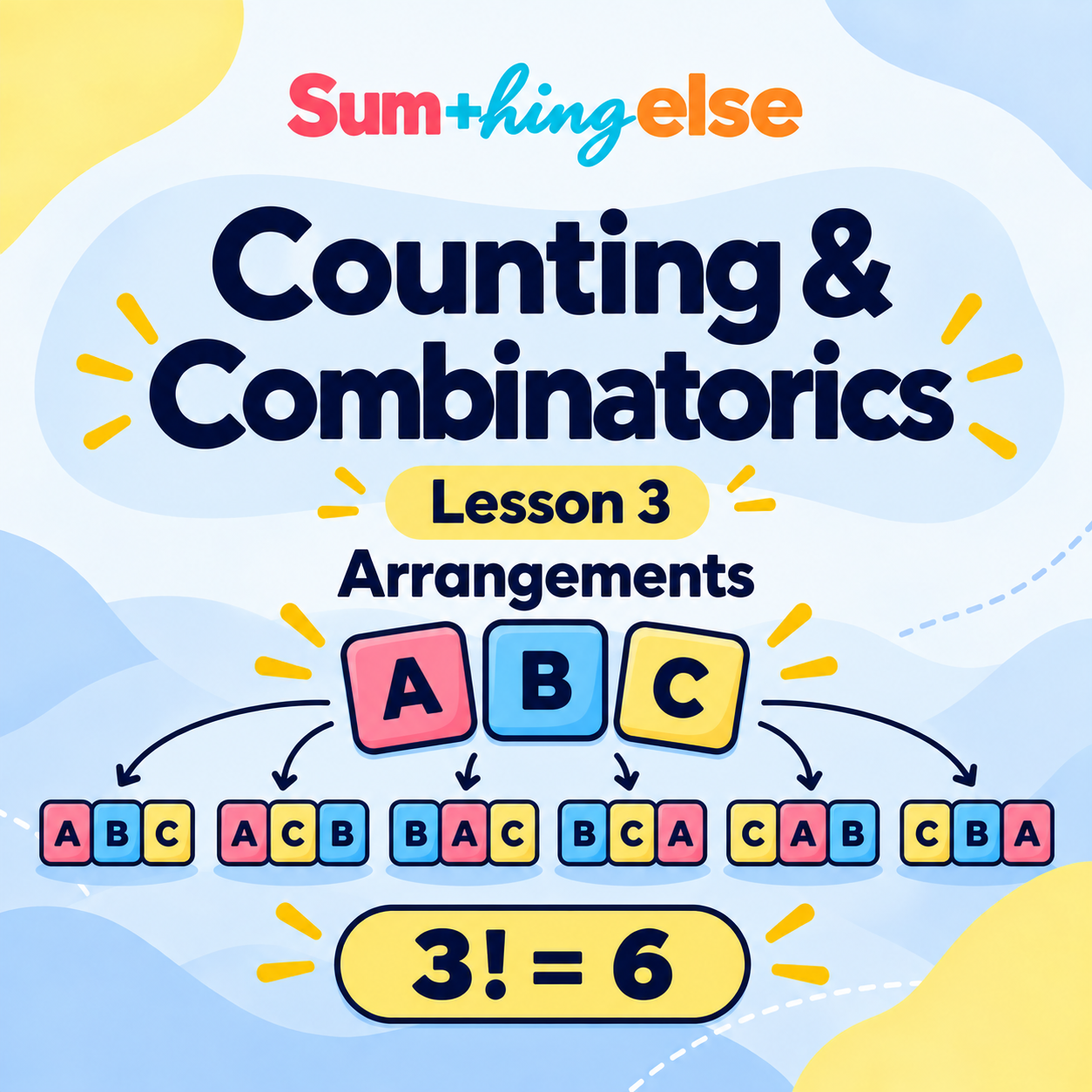
Download the printable handout, exercises and answers for Arrangements.
Find the resources →Next: Choosing without ordering
Suppose we choose Alice, Ben and Charlie for a team.
ABC, ACB, BAC, BCA, CAB and CBA all describe the same three-person team.
Our arrangement method would count the same choice six times. In the next lesson, we will learn how to correct that.
What did you think?
Whether you explored this together or worked independently, we would love to hear from both learners and parents. Tell us what you enjoyed, what was confusing, or what you would like to see next.
Share your feedback
The form is short and you do not need to give your name.