You already know lots of ways to count. In this final lesson, the challenge is different: how do you decide which idea to use?
A clever solution often starts by changing the question slightly. Can you count the opposite? Split the possibilities? Spot something symmetric? Count a simpler object instead?
You do not need to memorise these yet. We will meet them one at a time, then practise choosing between them at the end.
Trick 1: Count what is easier
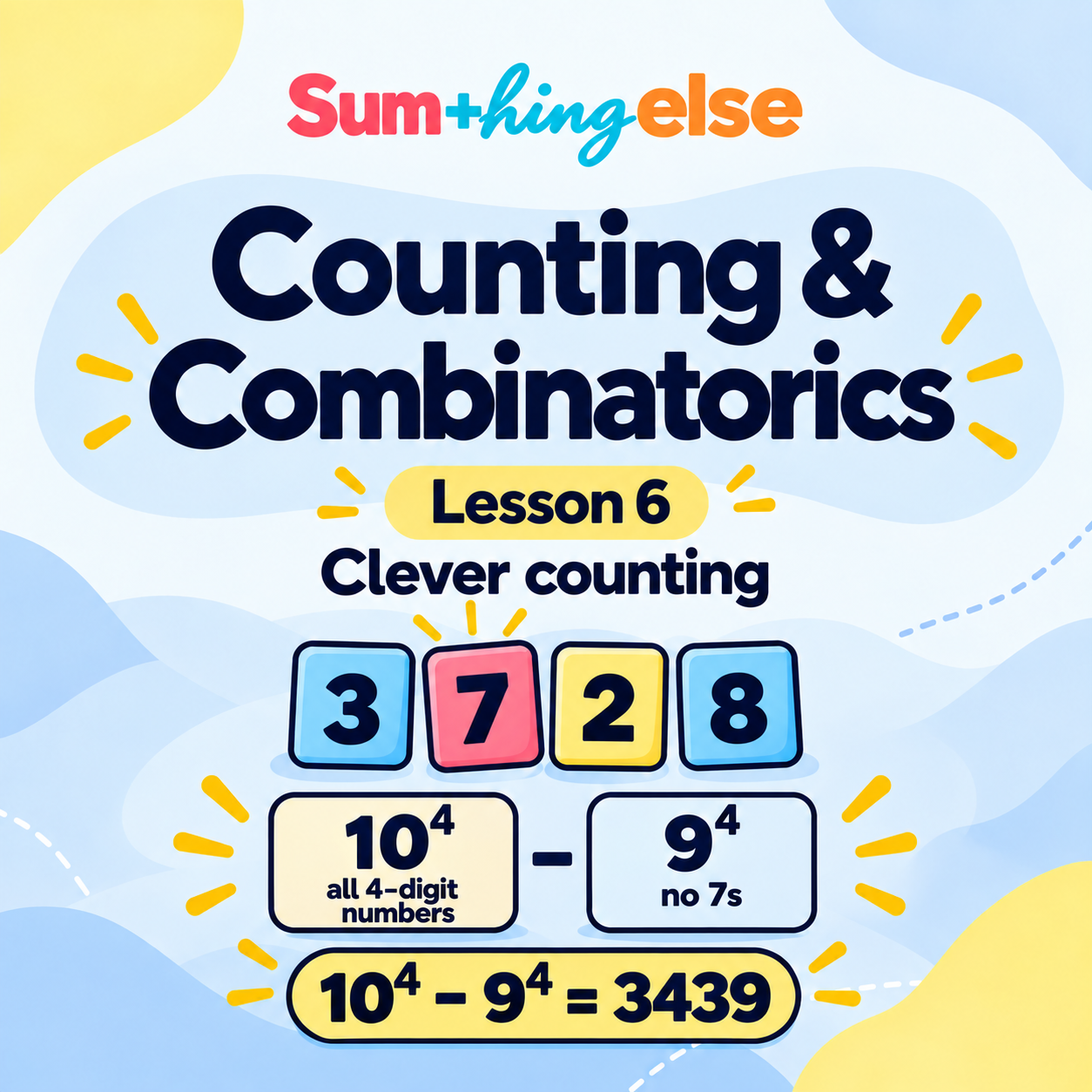
Suppose a four-digit code can use any digit from 0 to 9, and repetition is allowed.
How many codes contain at least one 7?
You could count codes with exactly one 7, then two 7s, then three… but that creates lots of cases. Instead, ask:
Reveal the easier question
No 7 at all. That is much easier to count.
If every possibility is either wanted or unwanted, then:
wanted = total − unwanted
A coin is tossed 5 times.
💡
Reveal answer
There are 25 = 32 sequences altogether.
Only one contains no heads: TTTTT.
32 − 1 = 31
So there are 31 sequences with at least one head.
Trick 2: Split into cases
The last problem asked for codes containing at least one 7. Counting the opposite was the shortest route.
Now change the question slightly:
A four-digit code uses digits 0–9, with repetition allowed. How many codes contain exactly one 7 or exactly two 7s?
This time there is no single easy opposite. Instead, recall the tree idea from earlier lessons: split the possibilities into branches that cannot overlap.
4 ways
9 choices each
9 choices each
Inside each case, choices happen in stages, so we multiply. The two cases cannot overlap, so after counting each branch we add them.
For a fixed registration area and a fixed half-year period, the first four characters are already determined. Suppose every car in this group begins with LK26.
The final three positions are letters. For this counting model, assume each can be any of the 26 letters A–Z.
💡
Reveal answer
Each of the final three positions has 26 choices.
26 × 26 × 26 = 263 = 17,576
So this model gives 17,576 possible plates for that fixed area and half-year code.
Suppose the same registration period includes cars beginning with either LK26 or LM26.
How many plates are possible altogether in this simplified model?
Reveal answer
Each area code gives 263 = 17,576 possibilities.
17,576 + 17,576 = 2 × 263 = 35,152
The two area-code cases are separate, so we add them.
Trick 3: Use symmetry
Symmetry means that two or more parts of a counting problem play exactly the same role. If nothing in the rules distinguishes them, their counts must be the same.
All 3-person teams are formed from six children: A, B, C, D, E and F.
If A appeared in more teams than B, there would have to be something in the rules that made A different. There is not. The same is true for every pair of children.
How many teams does each child appear in?
Fix one child, say A. Then choose A’s two teammates from the other five children.
choose 2 from 5 = 10
So every child appears in 10 teams.
When several objects or cases play exactly the same role, it can help to fix one of them and work out what happens there.
For example, instead of asking how often each of A, B, C, D, E and F appears, fix A and count the teams containing A. By symmetry, the same answer then applies to every other child.
Mathematicians often describe this as choosing a case without loss of generality: we are not making the problem more special, because any of the symmetric cases could have been chosen instead.
Another kind of symmetry: chosen and left out
You met this in Lesson 4. Choosing 3 people from 8 is equivalent to choosing the 5 people who are left out. Every chosen group has exactly one complementary left-out group.
A class has 20 students. Seventeen are chosen for an activity.
💡
Reveal answer
Choosing 17 students to take part is equivalent to choosing the 3 students who do not take part.
choose 17 from 20 = choose 3 from 20 = 1,140
The second description is much easier to calculate.
Trick 4: Notice when you count twice
One of the most powerful counting tricks is to count the same collection in two different ways.
Suppose 8 people each shake hands with every other person exactly once.
From each person’s point of view there are 7 handshakes, so:
8 × 7 = 56
But this counts every handshake twice — once from each end.
56 ÷ 2 = 28
A hexagon has 6 vertices. Join every pair of vertices by a straight line.
💡
Reveal answer
There are C(6,2) = 15 pairs of vertices.
Six of those pairs are sides of the hexagon.
15 − 6 = 9
So there are 9 diagonals.
Trick 5: Count a simpler object
Sometimes a complicated-looking problem becomes easy if we match each object we want to count with a simpler object.
For example, every subset of 7 objects corresponds to a seven-place yes/no pattern:
in, out, in, in, out, out, in
Each of the 7 positions has 2 choices, so there are 27 subsets.
A grid has 4 vertical lines and 5 horizontal lines.
💡
Reveal answer
Choose 2 of the 4 vertical lines:
C(4,2) = 6
Choose 2 of the 5 horizontal lines:
C(5,2) = 10
Every pair of vertical choices can be combined with every pair of horizontal choices:
6 × 10 = 60
So the grid contains 60 rectangles.
This idea is a little more advanced than the rest of the lesson. It is usually called stars and bars: the objects are shown as stars (or dots), and bars divide them into groups. Try it if you would like an extra challenge, or skip ahead to the final counting toolbox.
Here is a surprisingly useful way to count how identical objects can be shared between different groups.
How many different ways can five identical sweets be shared between A, B and C? A child is allowed to receive none.
Instead of writing three numbers, represent each sweet by a star and use two bars to divide the stars into three groups.
So every sharing is encoded by arranging 5 stars and 2 bars. Consecutive bars are allowed: for example | | ★ ★ ★ ★ ★ means A and B get none and C gets all five.
Five sweets and two fences make seven positions altogether. Different fence positions describe different shares between A, B and C.
★ ★ | ★ | ★ ★
A gets 2, B gets 1, C gets 2.
| ★ ★ | ★ ★ ★
A gets 0, B gets 2, C gets 3.
★ ★ ★ | | ★ ★
A gets 3, B gets 0, C gets 2.
Why are consecutive fences allowed?
Two fences next to each other mean that the group between them receives nothing.
For example, ★ ★ ★ | | ★ ★ means A gets 3, B gets 0 and C gets 2.
Every sharing uses 7 positions: five sweets and two fences. Once we choose which 2 positions contain fences, everything else is determined.
So there are 21 ways to share five identical sweets between three children when zero is allowed.
What is the general rule?
To share n identical objects between k groups, use n objects and k − 1 fences.
That gives n + k − 1 positions altogether, and we choose the k − 1 fence positions:
C(n + k − 1, k − 1)
This method is often called stars and bars. The name is less important than the picture: objects separated by fences.
Do not calculate. Decide which counting idea would make each problem simplest, then open the answer.
A 5-toss coin sequence contains at least one head.
Count the opposite. Counting the single all-tails sequence is much shorter than splitting into one-head, two-head, three-head, and so on.
A meal is starter + main + dessert.
Multiply stages. One choice is followed by another.
A ticket is either child or adult, with different price options.
Split into cases. The two ticket types are separate alternatives, so count each case and add.
Every pair of 8 people shakes hands once.
Count the same thing twice. Counting from each person counts each handshake once from each end.
All 3-person teams are formed from 6 equally placed children.
Use symmetry. No child has a special role, so every child must appear equally often.
Your counting toolbox
There is rarely just one way to solve a counting problem. Before calculating, ask what structure the problem has. Use the wheel to jump back to a strategy.
The first five routes take you back to the earlier lessons; the other five jump to the strategy sections in this lesson.
The arithmetic is often the easy part. The real skill is finding a way to organise the possibilities so that every object is counted exactly once — or understanding precisely why you have counted it more than once.
You have reached the end of the Counting & Combinatorics course.
Download the printable handout, exercises and answers for Clever Counting.
Find the resources →What did you think?
Whether you explored this together or worked independently, we would love to hear from both learners and parents. Tell us what you enjoyed, what was confusing, or what you would like to see next.
Share your feedback
The form is short and you do not need to give your name.