
Some shapes fit together neatly. Others leave mysterious little gaps.
In this lesson, you are going to experiment first. Your job is to find out which shapes can cover a surface without gaps and without overlaps.
You can slide, flip and turn the shapes.
Start with a prediction
Which of these shapes do you think could cover a floor completely?
Make a guess before you test them. It is completely fine if your guess changes later.
Tiling lab
Use the interactive board to place copies of a shape, move them around and turn them. Try to make the pieces meet exactly.
If the activity does not load, or you want to use the lab in the full screen mode, open the tiling lab in a new tab.
Try the shapes one at a time. Before deciding that a shape does not work, try turning it.
What did you notice?
A new mathematical word
When copies of shapes cover a surface without gaps and without overlaps, the pattern is called a tessellation.
Squares tessellate. Triangles tessellate. Regular hexagons tessellate. Circles do not tessellate by themselves, because gaps remain between them. Regular pentagons do not tessellate by themselves either.
Why do some shapes fit?
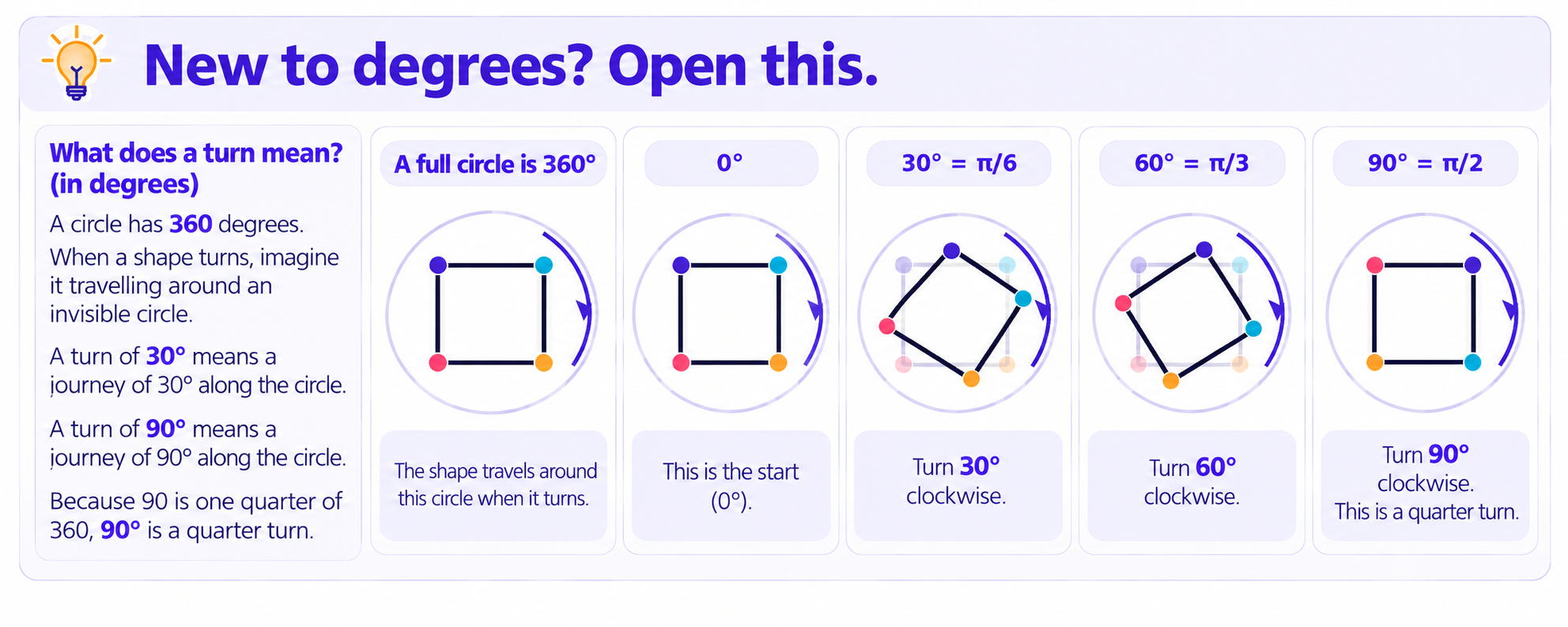
Look at a point where several corners meet. If the corners fit perfectly around that point, they make one complete turn.
Triangles: 6 corners of 60° make 360°.
Squares: 4 corners of 90° make 360°.
Regular hexagons: 3 corners of 120° make 360°.
Go further
Here is a surprise: every quadrilateral can tessellate, even if it looks wonky.
Try the odd quadrilateral in the tiling lab. You may need to turn copies around before the pattern appears.
Can you explain why a regular pentagon is more awkward? Its corner angle is 108°. Is there a whole number of 108° corners that makes exactly 360°?
A stranger kind of tessellation
Some tessellations cover a surface perfectly but never repeat in the usual way. A famous example is a Penrose tiling, named after mathematician Roger Penrose. It uses just a small number of specially shaped tiles, but however far the pattern continues, you never get one repeating block that simply slides across the whole design.
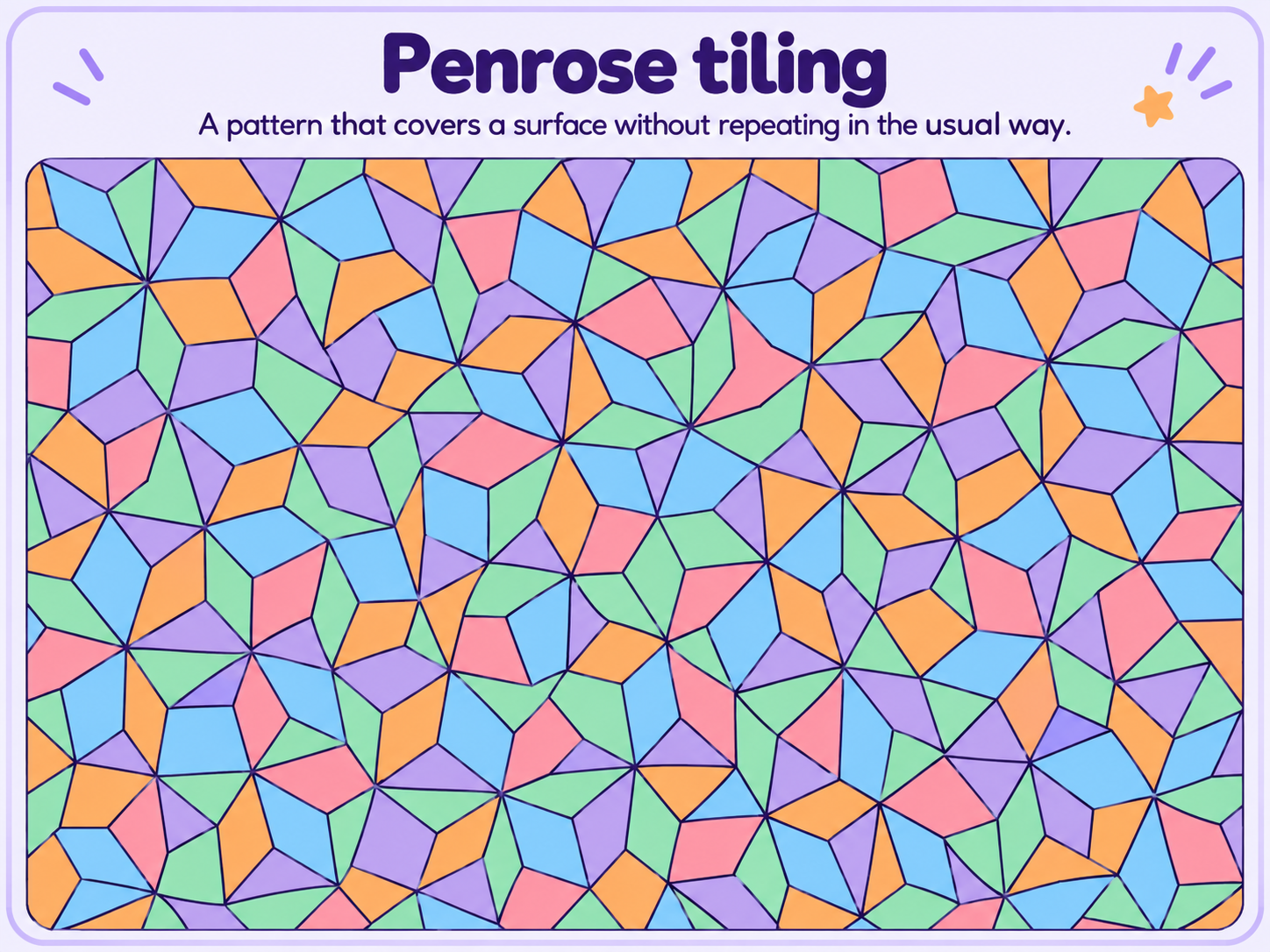
Can you imagine a different pattern that keeps going forever without ever repeating exactly?
Practice puzzle
A shape leaves a gap. Does that prove it cannot tessellate?
Come back to it later
Tessellations are much easier to understand when you can cut out the shapes, turn them around and try the patterns for yourself. Our printable puzzle pack gives you another chance to explore the ideas from this lesson away from the screen.
Tessellation Puzzles
Cut, turn, fit and discover. Explore why every triangle tessellates, experiment with a wonky quadrilateral, investigate regular polygons, build a Penrose pattern and try an Escher-inspired tessellation.
Get the free puzzle pack →Next we will investigate another kind of pattern: symmetry. Instead of asking whether shapes fit together, we will ask whether one part of a picture matches another.
What did you think?
Whether you explored this together or worked independently, we would love to hear from both learners and parents. Tell us what you enjoyed, what was confusing, or what you would like to see next.
Share your feedback
The form is short and you do not need to give your name.