
Some pictures feel balanced before we can explain why. One side seems to answer the other.
In this lesson, you are going to become a symmetry detective: looking for hidden mirror lines, testing shapes, and deciding when a match is exact — and when it is only almost exact.
Where would you put the mirror?
Imagine a butterfly, a face and a leaf. For each one, where could you draw a line so that one side looks like a reflection of the other?
Do not worry about the mathematical name yet. First, look for the line that seems to split the picture into matching halves.

Where would you put the mirror line? Look at one butterfly. Imagine drawing a line through its body. Would the two wings match if you folded the photograph along that line?
Fold it in your imagination
A useful test is to imagine folding a picture along your chosen line. If every point on one side lands exactly on a matching point on the other, the picture has a special kind of symmetry.
Where would you try the fold?
Could the left and right sides match?
Does the central vein behave like a mirror line?
Mirror lab
Now make your own symmetric picture. Draw on one side of a mirror line and watch what happens when every mark is reflected.
Now give the idea a name
A shape has reflection symmetry if it can be reflected across a line and still match itself exactly. That line is called a line of symmetry.
You can also think of the line of symmetry as a fold line. If the two halves land exactly on top of each other, the fold works.
Go on a mirror-line hunt
If you have a small mirror, stand it upright on top of a shape. Move it around until the reflection completes the shape.
Try a square, rectangle, equilateral triangle and a shape of your own.
How many different places can you put the mirror and still make the whole shape? Make a prediction before you test each one.
How many mirror lines?
Some shapes have one line of symmetry. Some have several. Some have none at all. Make a prediction for each shape before opening the answer.
Square
Rectangle
Equilateral triangle
Scalene triangle
Circle
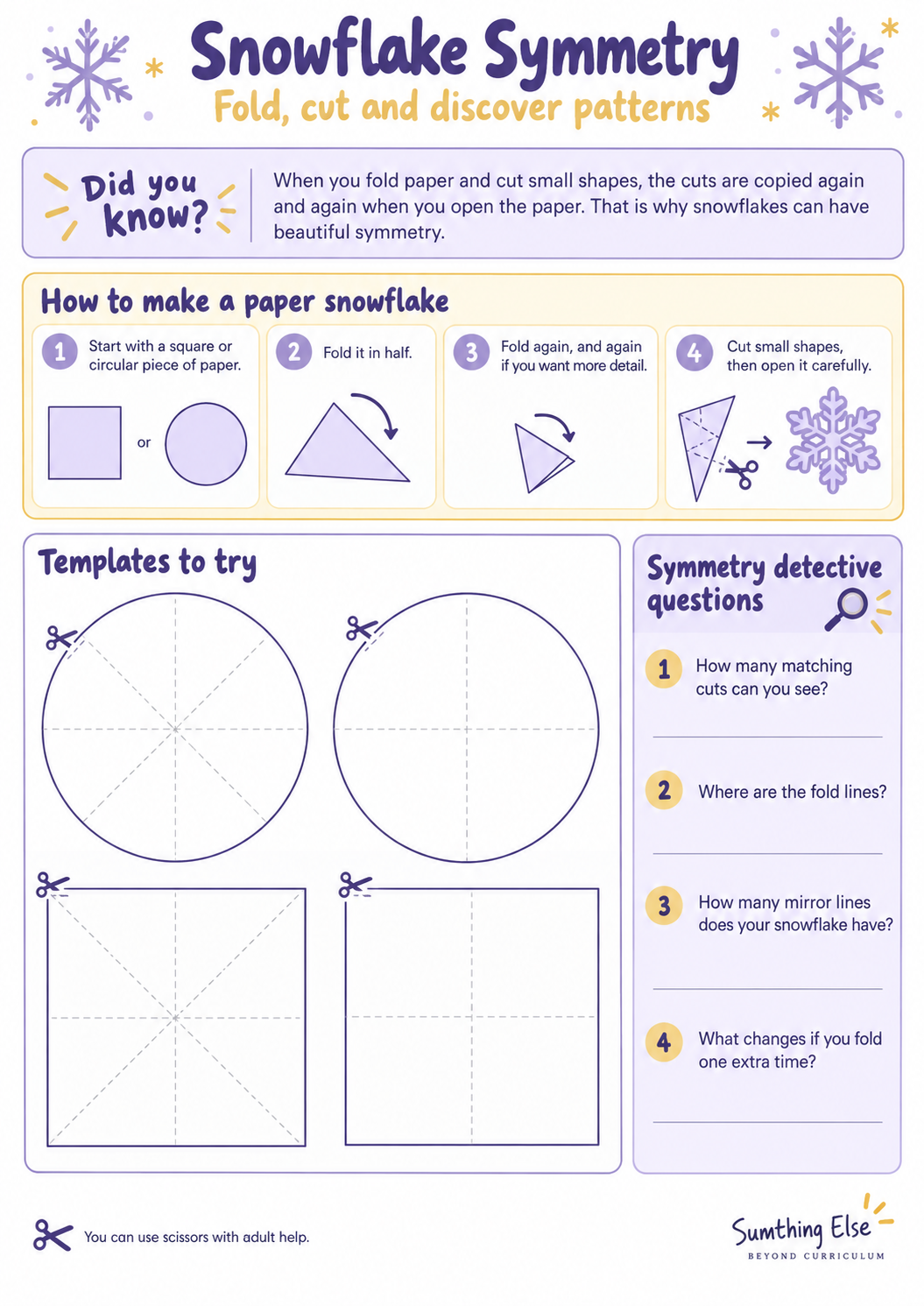
Make a paper snowflake
Take a square or circular piece of paper. Fold it in half, then fold it again. You can fold it one more time if you want a more detailed pattern.
Now carefully cut small shapes from the folded edges: triangles, semicircles, zigzags or tiny notches.
Unfold the paper.
What happened to each cut? How many matching copies appeared?
Can you find all the fold lines in your finished snowflake? Which of them are lines of symmetry?
What changes if you fold the paper one extra time before cutting?
Every fold acts like a mirror line. When you cut through several folded layers at once, the same cut appears in several reflected positions when the paper is opened.
Snowflake Symmetry
Print the template, fold the paper, cut your own shapes and then investigate the symmetry you created.
Exact — or almost?

The moth: the wings look strongly symmetric. But can you find any tiny differences between the two sides?

The reflection: where is the mirror line here? Is the reflected branch exactly the same as the real one?
Mathematical symmetry is exact. Real objects in nature are more complicated. A butterfly may look beautifully symmetric, but one wing can have a tiny mark that the other does not. A leaf can grow unevenly. A starfish can have arms of slightly different lengths.
Symmetry detective question: if something looks symmetric from a distance but the two sides are not perfectly identical, would you call it mathematically symmetric, approximately symmetric, or neither?
This is where your real-world detective work matters. Look closely rather than assuming that nature must behave like a perfect geometric diagram.
Practice puzzle
Can you design a shape with exactly one line of symmetry?
Then try to design shapes with exactly 2, exactly 4, and 0 lines of symmetry.
A different kind of symmetry
A mirror line is not the only way a shape can match itself. Look at this starfish.
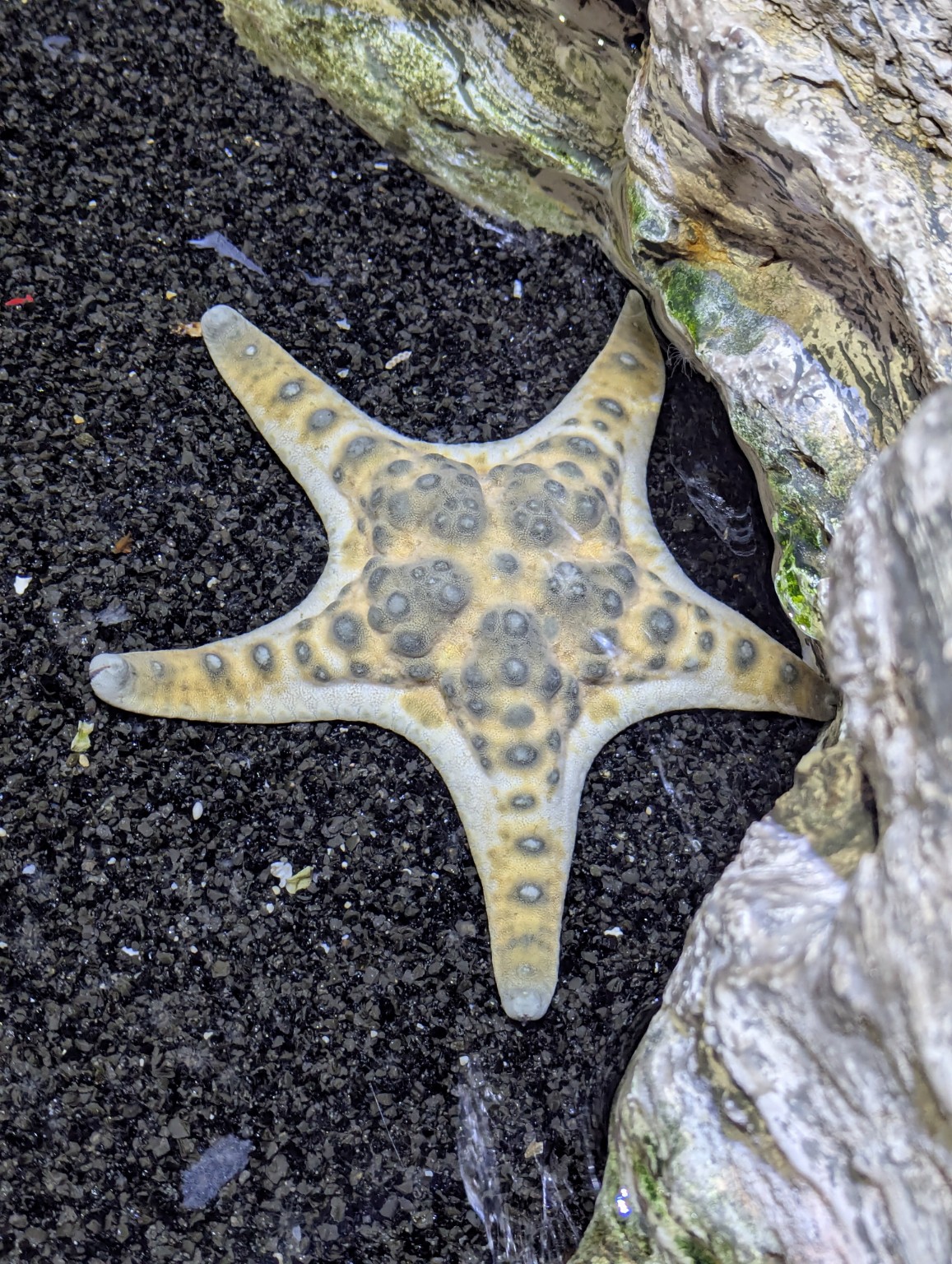
Instead of folding it, imagine turning it. If you rotate the starfish around its centre, could it look almost the same again?
With five arms, there are several positions during one complete turn where the starfish looks approximately the same. This is an example of rotational symmetry.
Make a star with two mirrors
So far we have mostly used one mirror. But something surprising happens when two mirrors meet at an angle.
Each mirror reflects the object — and it can also reflect the image made by the other mirror. One drawing can suddenly appear again and again.
Two mirrors, many copies
Stand two small mirrors on their edges so that they meet like an open book. Put a coloured shape or drawing close to the corner where they meet.
Look into the mirrors. Then slowly change the angle between them.
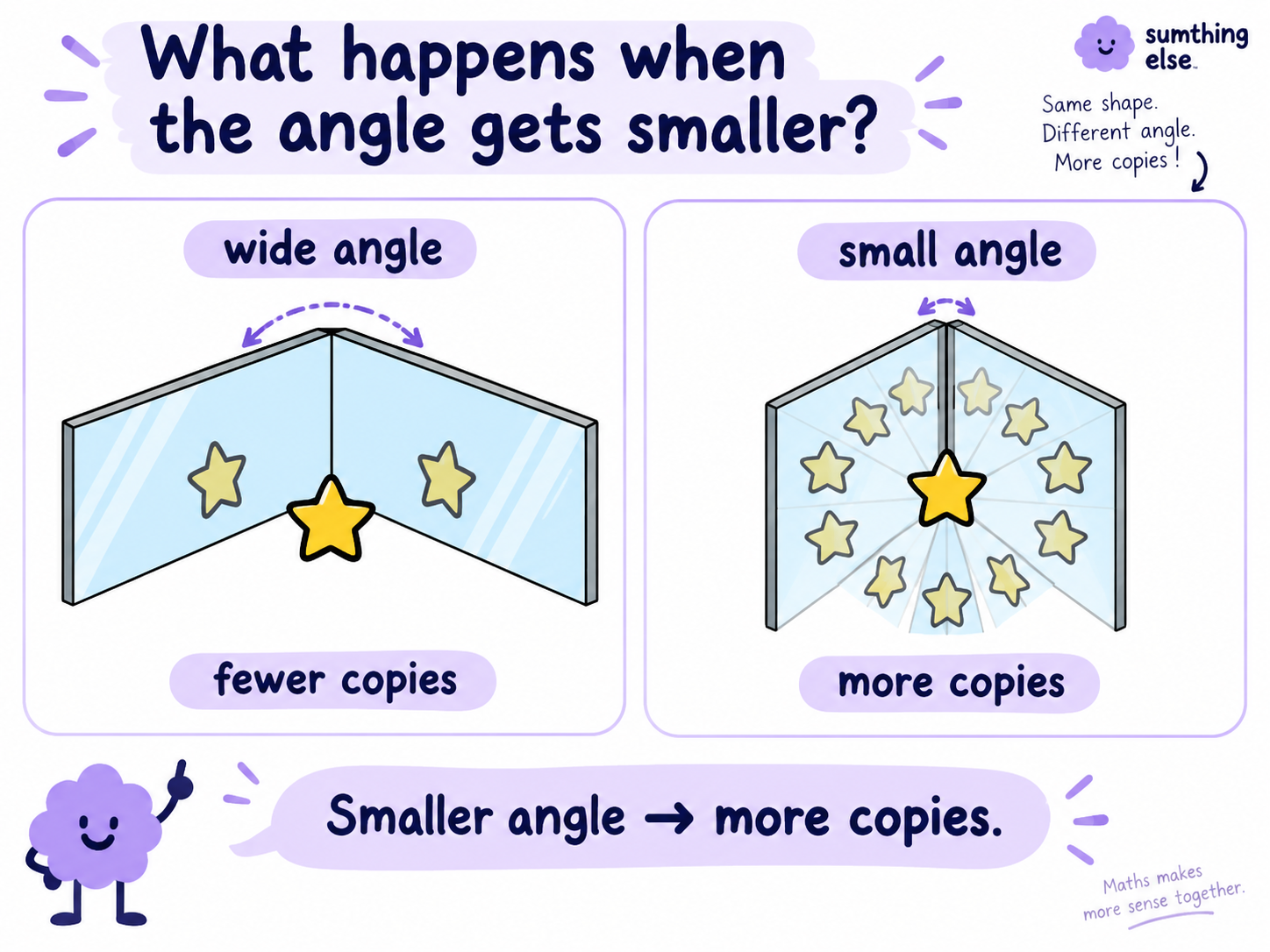
What happens to the number of reflections as you bring the mirrors closer together?
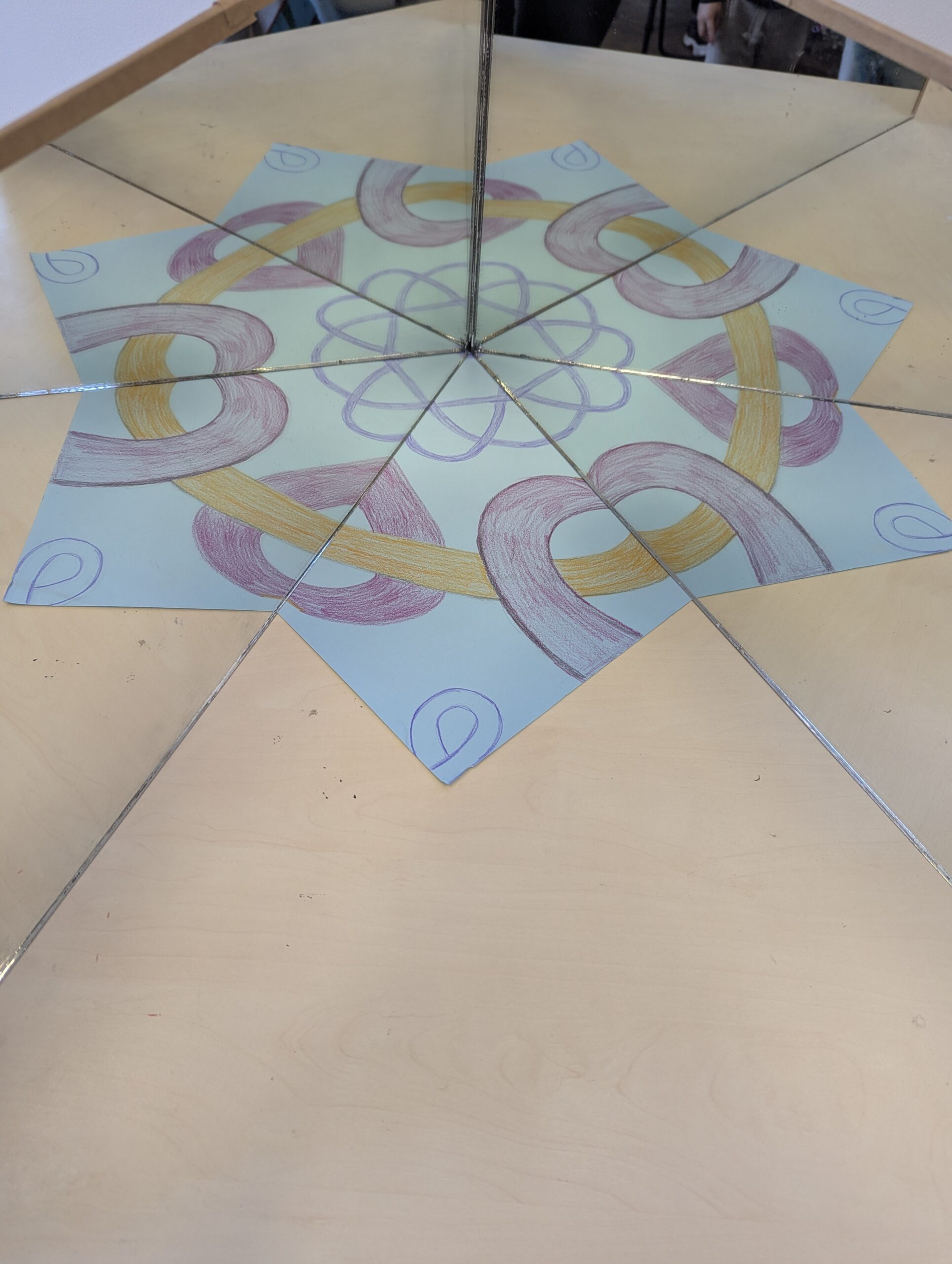
Start with the mirrors fairly wide apart. Already, one part of the drawing appears several times.
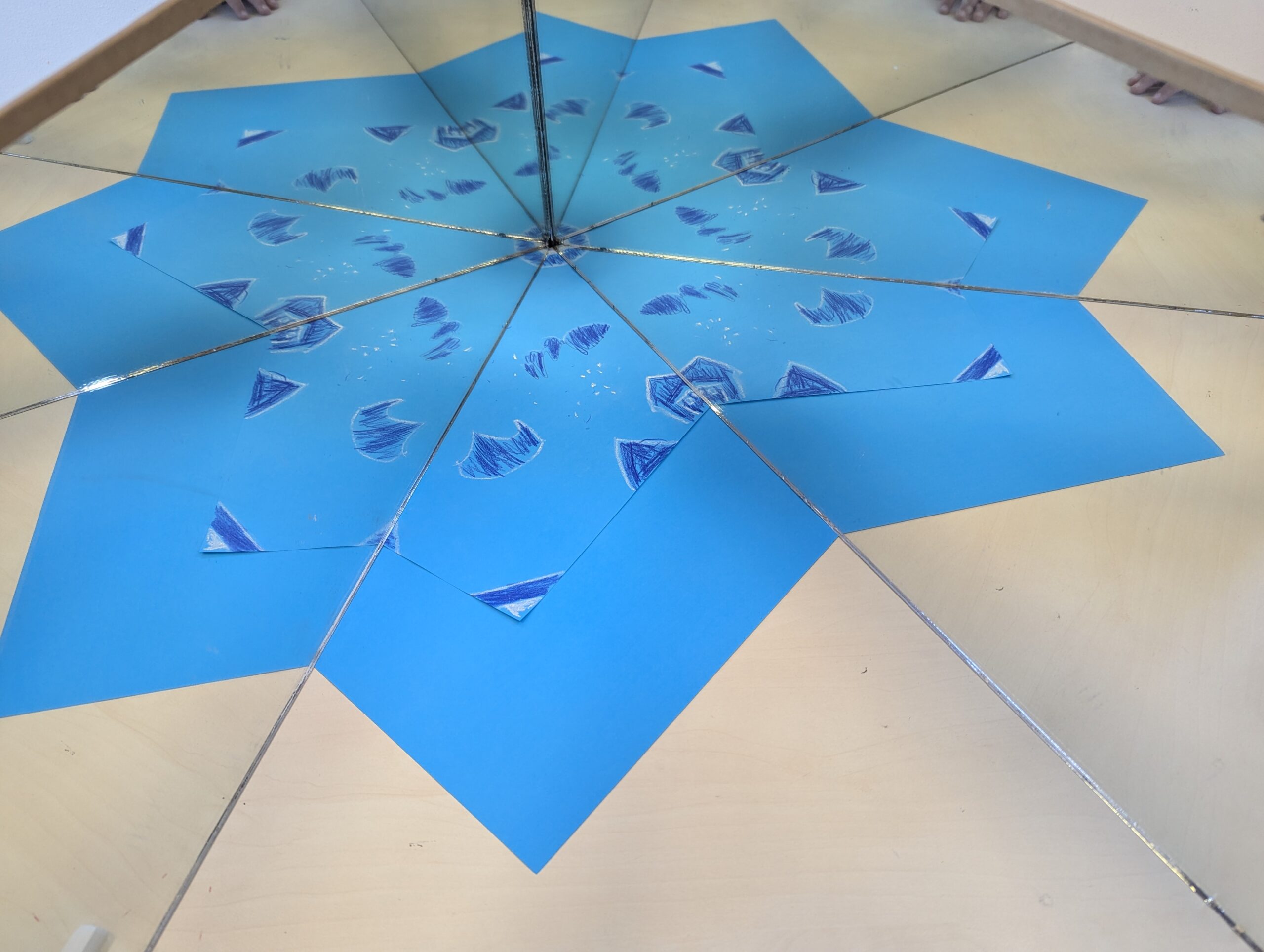
The repeated pieces begin to make a star-like pattern around the point where the mirrors meet.
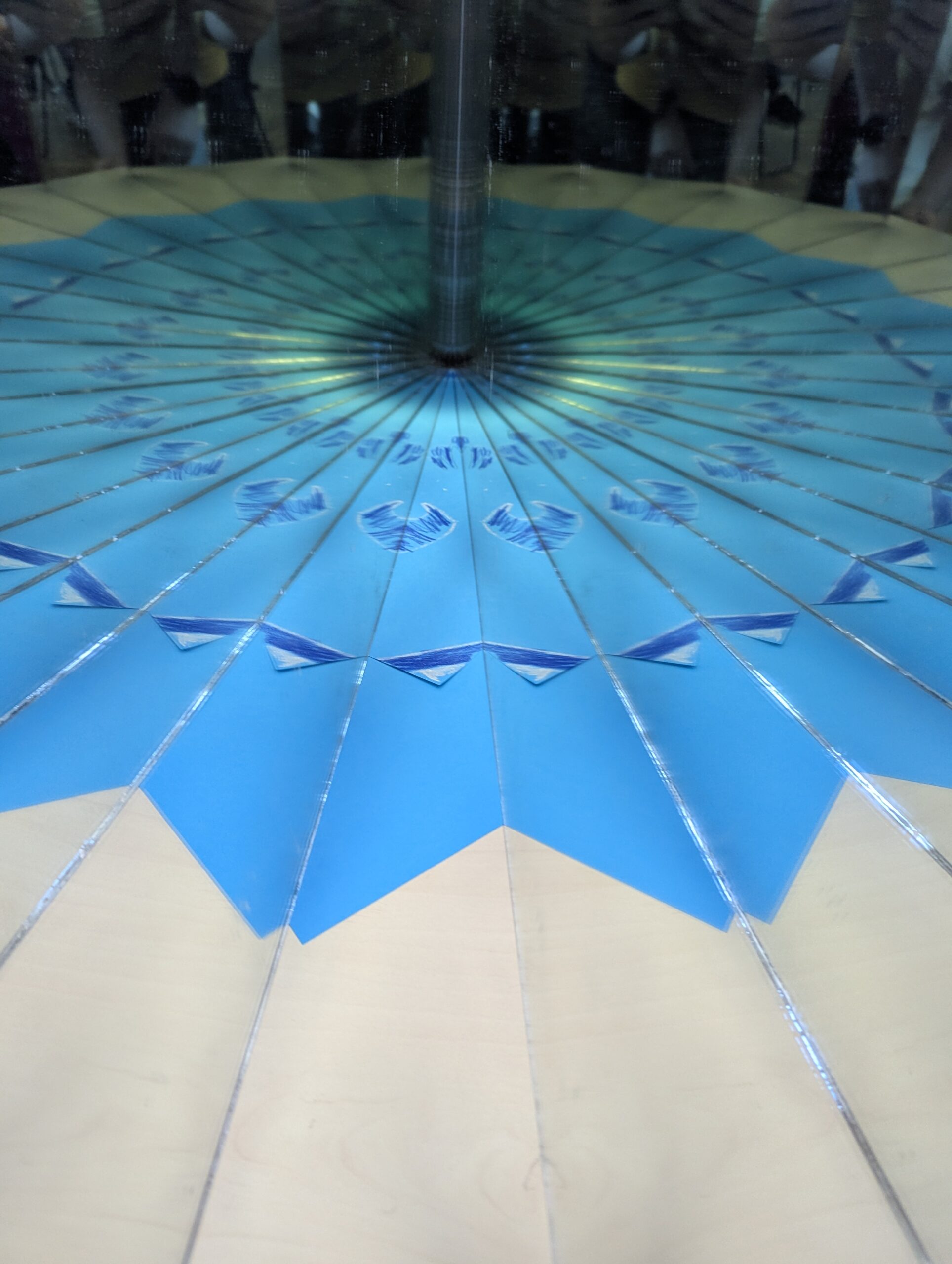
Bring the mirrors closer together and even more copies appear. The pattern is divided into many narrow sections around the centre.
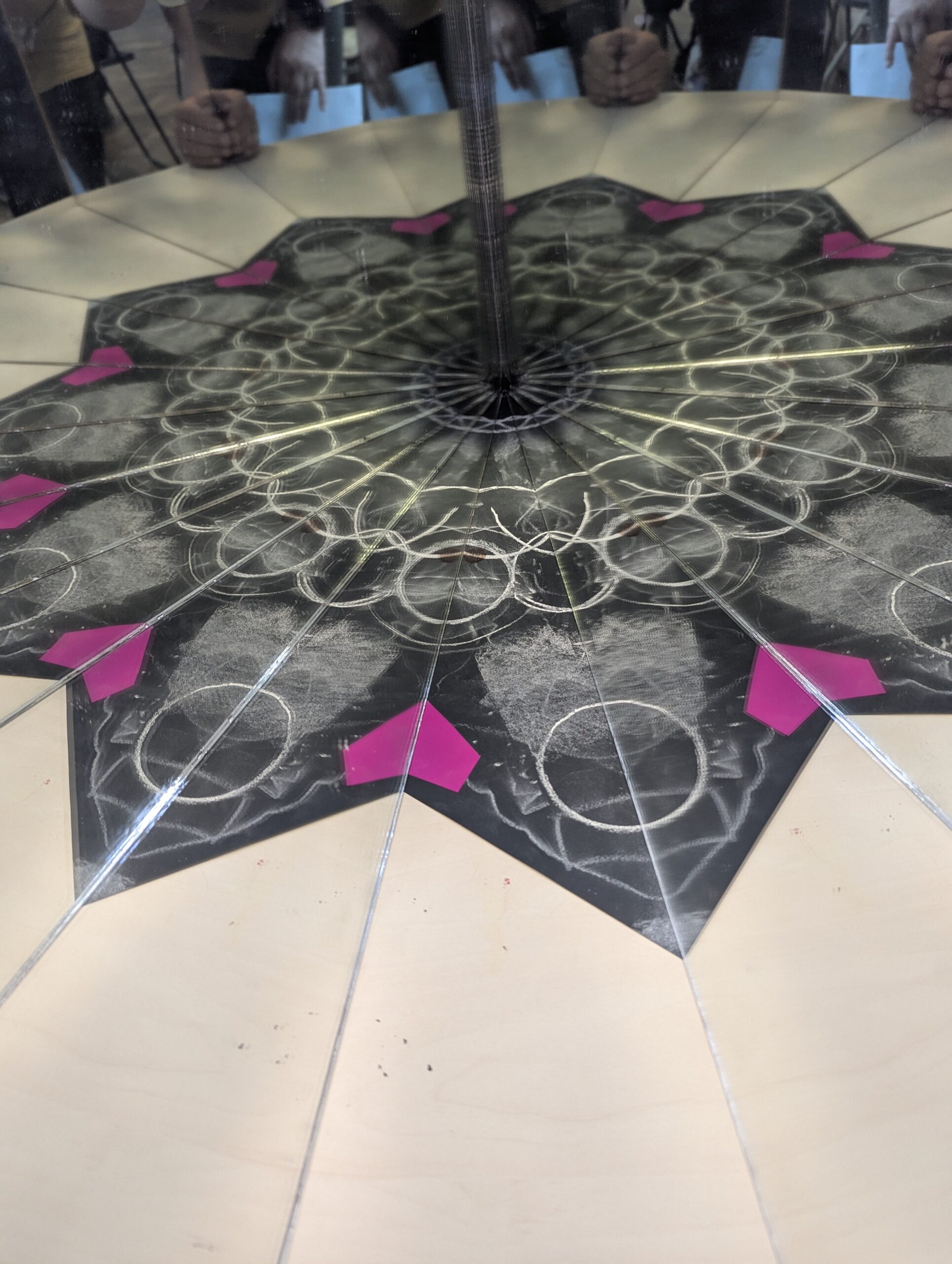
A small piece of drawing can turn into a whole kaleidoscope-like design.
Can you predict the pattern?
A complete turn around the centre is 360°. If the mirrors divide that turn into equal angles, we can predict how many sections appear.
4 sections
6 sections
8 sections
12 sections
The smaller the angle between the mirrors, the more times the pattern can repeat around the centre.
The mirrors create repeated reflections, but the complete star-like pattern can also have rotational symmetry. Turn it around its centre and it can match itself again.
Suppose the angle between the mirrors is 40°.
How many equal 40° sections fit into one complete 360° turn?
Make your own kaleidoscope
You have already seen how two mirrors can turn one small drawing into a whole star of reflections. A kaleidoscope uses the same idea — but puts the mirrors inside a tube.
Can you build a kaleidoscope from a cardboard paper-towel roll?
How does a kaleidoscope work?
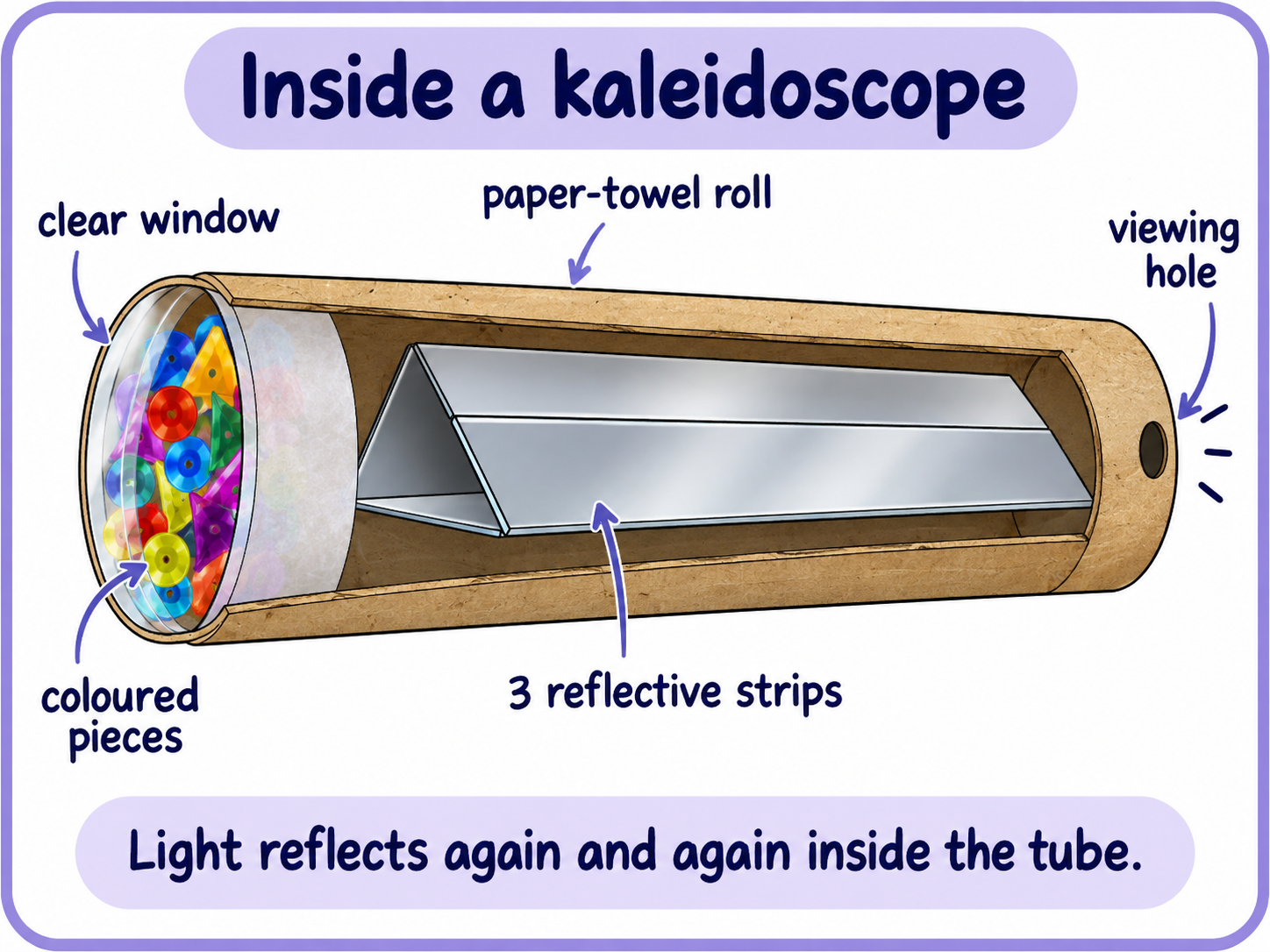
Inside a kaleidoscope are several shiny surfaces arranged so that they face one another. Light bounces from one surface to another, making reflections of reflections.
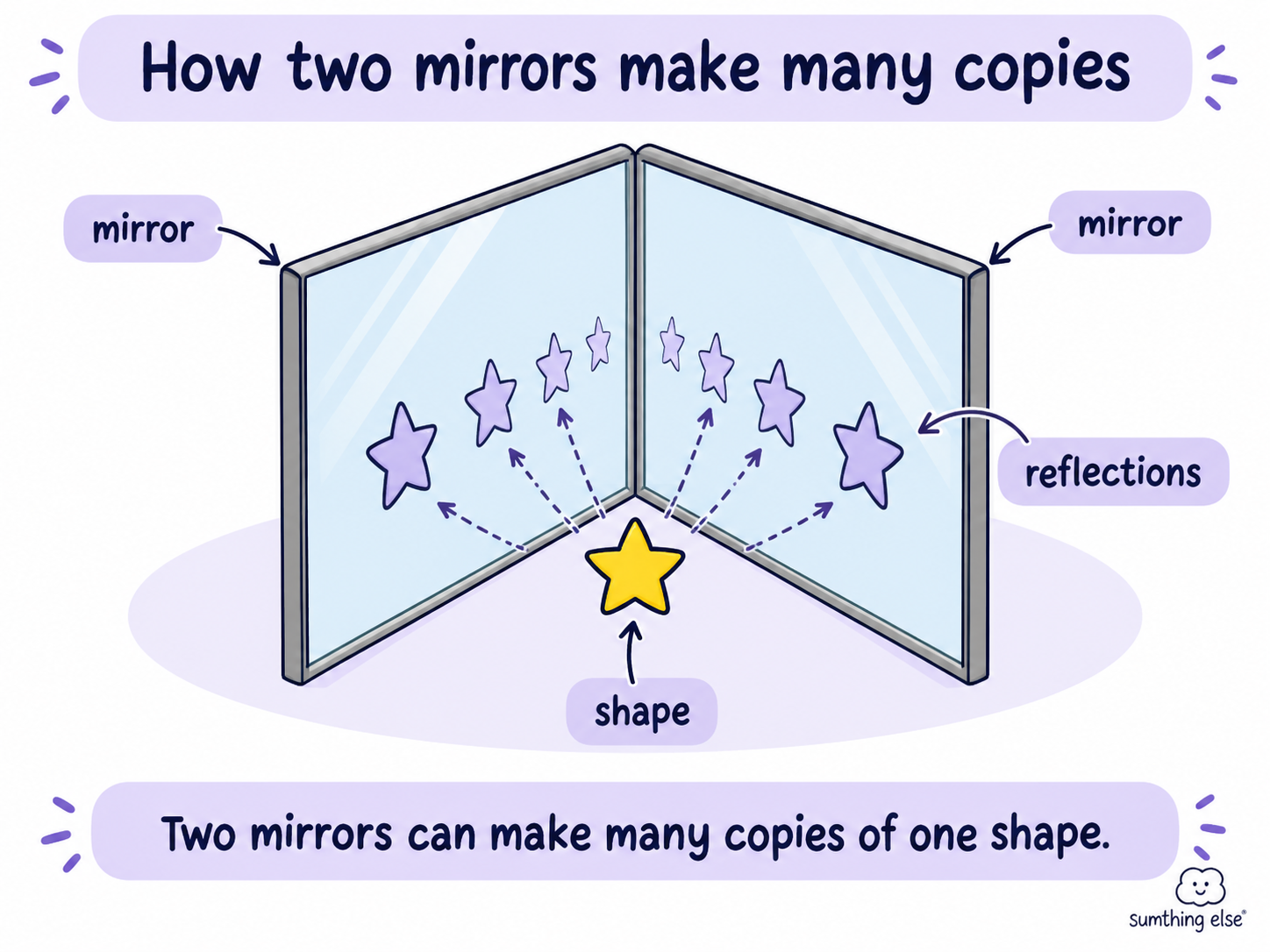
A tiny coloured shape can therefore appear many times. Together, all those reflected copies make a symmetrical pattern.
When you turn the kaleidoscope, the coloured pieces at the end move. The mirrors stay in the same arrangement, but the picture being reflected changes — so a completely new pattern appears.
The mirrors repeatedly reflect the same shapes. Because the reflections are arranged around the centre, the finished picture often has both reflection symmetry and rotational symmetry.
Build one from a paper-towel roll
You will need:
- an empty cardboard paper-towel roll
- three strips of reflective card or plastic mirror sheet
- tape
- card
- clear plastic or acetate
- tracing paper or baking paper
- a few small colourful sequins, beads or pieces of transparent plastic
- scissors
Use plastic mirror sheet or reflective card rather than glass. Younger children may need adult help with cutting.
What to do
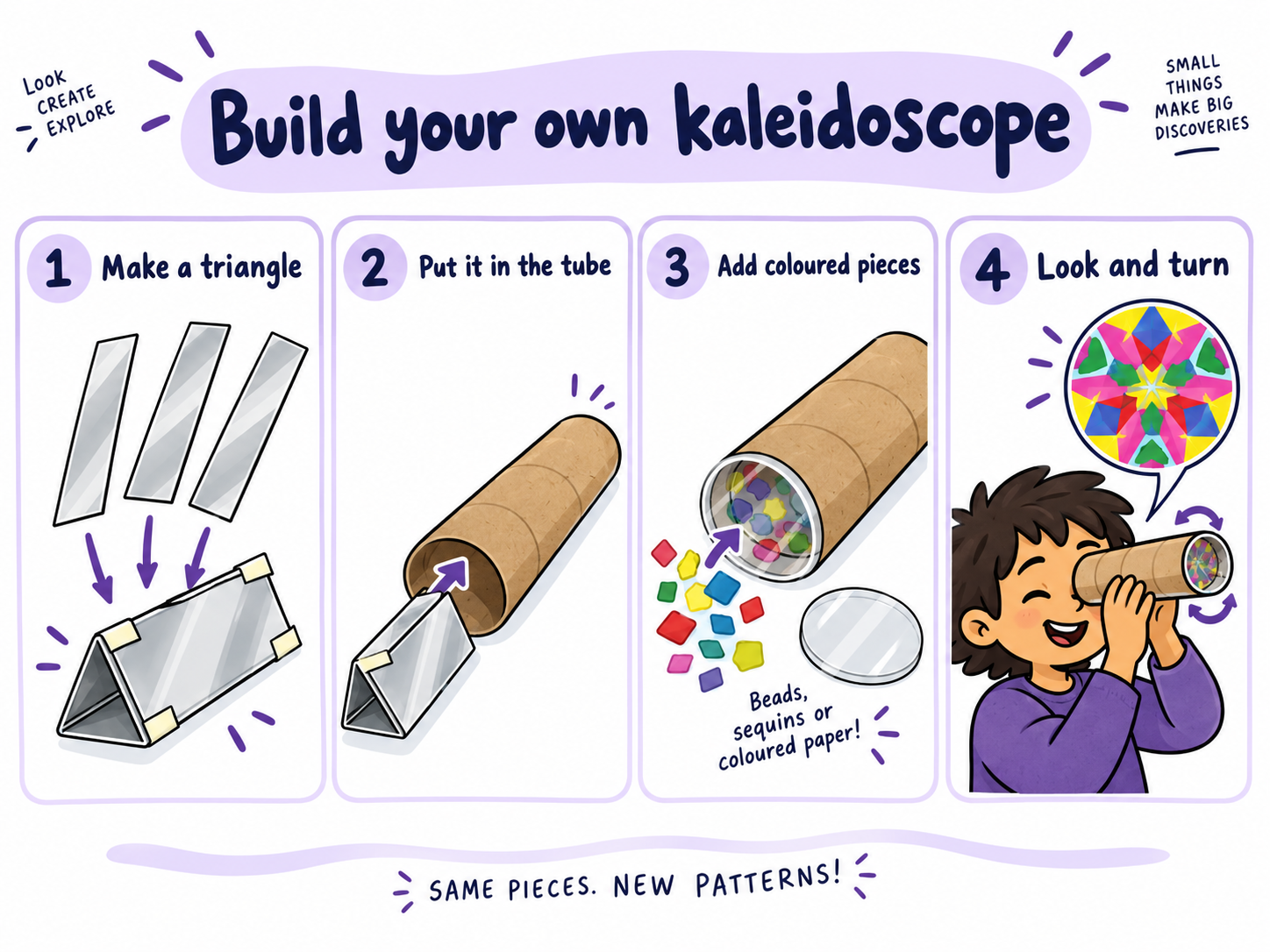
- Cut three long strips of reflective card, slightly shorter than your tube.
- Tape the strips together along their long edges so that they fold into a long triangular tunnel, with the shiny sides facing inwards.
- Slide the triangular mirror tunnel inside the cardboard roll.
- At one end, add a clear plastic circle. Place a few colourful pieces on it.
- Cover the coloured pieces with tracing paper or another translucent layer, leaving just enough room for the pieces to move when the tube turns.
- At the other end, add a card circle with a small viewing hole in the centre.
- Point the coloured end towards a bright window or lamp, look through the hole, and slowly turn the tube.
Watch one coloured piece carefully. How many copies of it can you see? Can you spot any mirror lines? How far do you have to turn the kaleidoscope before the pattern looks similar again?
Try changing the coloured pieces inside your kaleidoscope. Does changing their shape, colour or position change the kind of symmetry you see?
Then compare your kaleidoscope with the two-mirror experiment above. What is the same? What is different?
Help us improve Sumthing Else
Did you try this lesson together? We’d love to know what worked, what was confusing, and what you would like to explore next. Parents and children are both welcome to answer.
Give feedback →Next we will take the same ideas and make them move: slide, turn and flip.