
So far, most of our patterns have lived on flat surfaces. We have tiled floors, found mirror lines, turned shapes around a centre and repeated motifs across a page.
Now we are going to explore 3D shapes — shapes you can pick up and hold.
Can a solid shape be symmetrical? Which special 3D shapes can we make? Can we pack shapes together with no gaps? And why are there always little spaces between balls?
A note for parents and grown-ups
This lesson is a little more advanced than the earlier Patterns lessons. It introduces some new vocabulary, but learners do not need to remember all of the words.
Think of this lesson as inspiration for children who are keen to explore further. Most of the ideas can be understood very well by playing with real objects.
A ball and a cube are excellent starting points. A Rubik’s Cube, building blocks, boxes, oranges, marbles or toy balls can all help make the ideas much easier to see.
Try turning the objects, looking for matching halves, stacking them, and noticing where gaps appear. The hands-on exploration matters much more than learning the technical vocabulary.
Look around you
Find three solid objects near you — perhaps a box, a mug, a ball, a book or a building block.
Which one looks most symmetrical? Could you cut it into two mirror-image halves? Could you turn it and make it look unchanged?
1. Symmetry moves into 3D
From a line to a plane
On a flat shape, we use a line of symmetry. You can imagine that line as a piece of thread or wire laid across the shape.
In 3D, a line is not enough. We need a whole flat surface passing through the object.
You can also imagine slicing straight through the object with a knife. The flat cut made by the knife shows where the plane would be.
If the two sides are mirror images of each other, that sheet lies in a plane of symmetry.
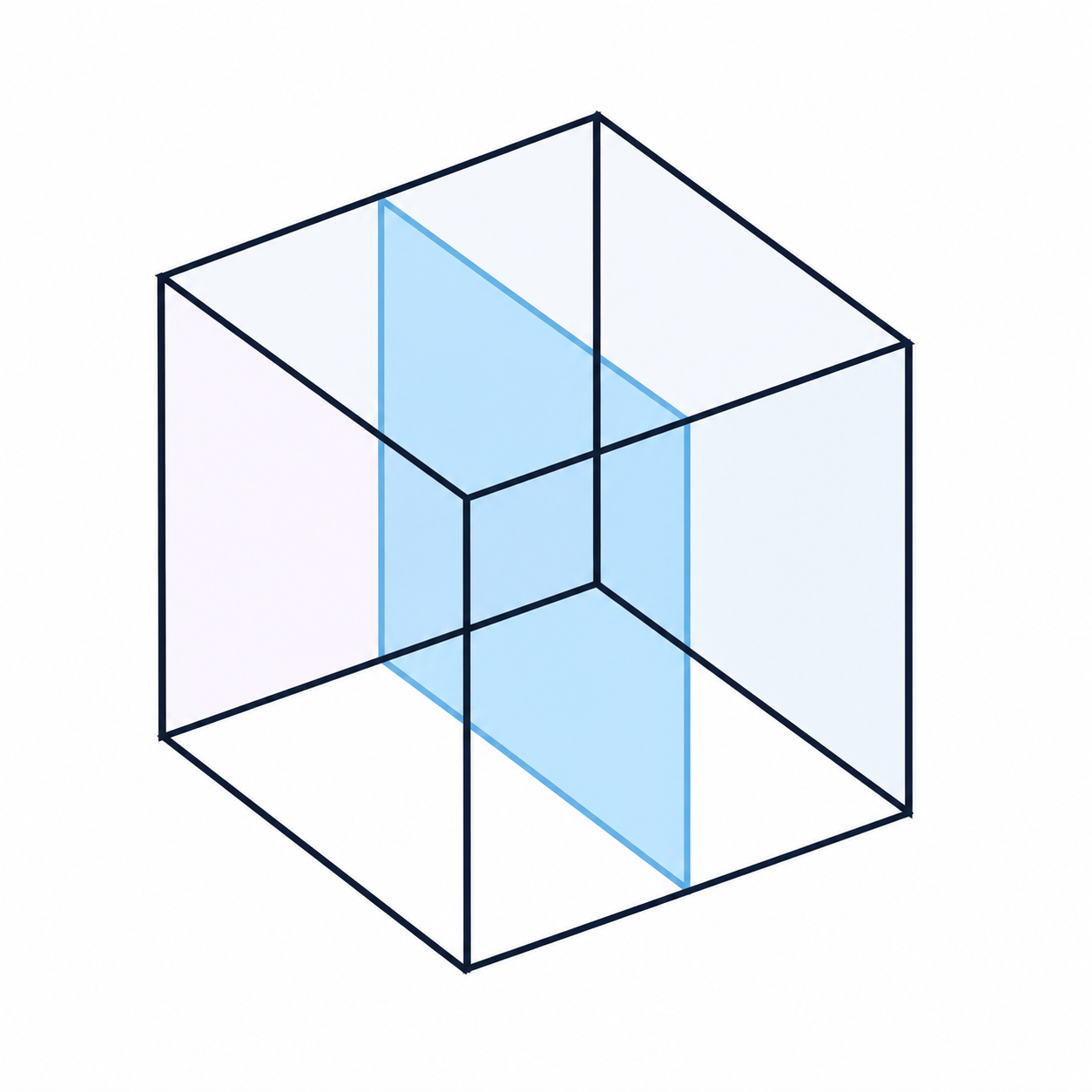
How many different ways could you slice a cube into matching mirror halves?
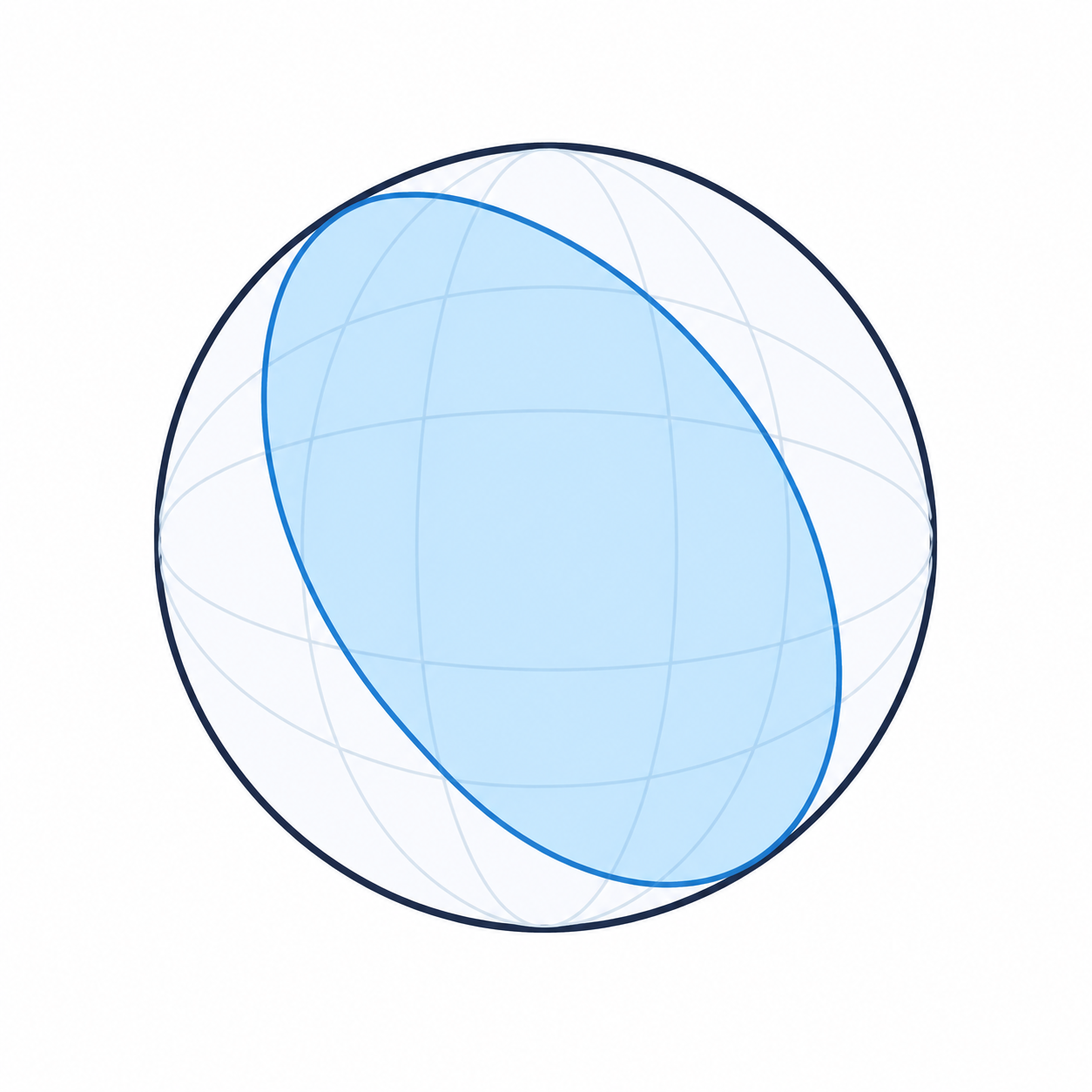
Can you choose a plane through the centre that does not split a perfect ball into matching halves?
Three-dimensional objects can also have rotational symmetry. Instead of turning around a point on the page, a solid turns around an axis — an imaginary straight line passing through it.
2. Meet the five Platonic solids
Some solids are extraordinarily regular. A Platonic solid has the same regular polygon for every face, and the same number of faces meet in the same way at every vertex.
Ignore the faces for a moment and keep only the corners and edges. Each corner becomes a vertex and each solid edge becomes a graph edge. A cube, tetrahedron or other Platonic solid can therefore be turned into a graph. See how vertices, edges and degree work in Graphs: What is a graph? →
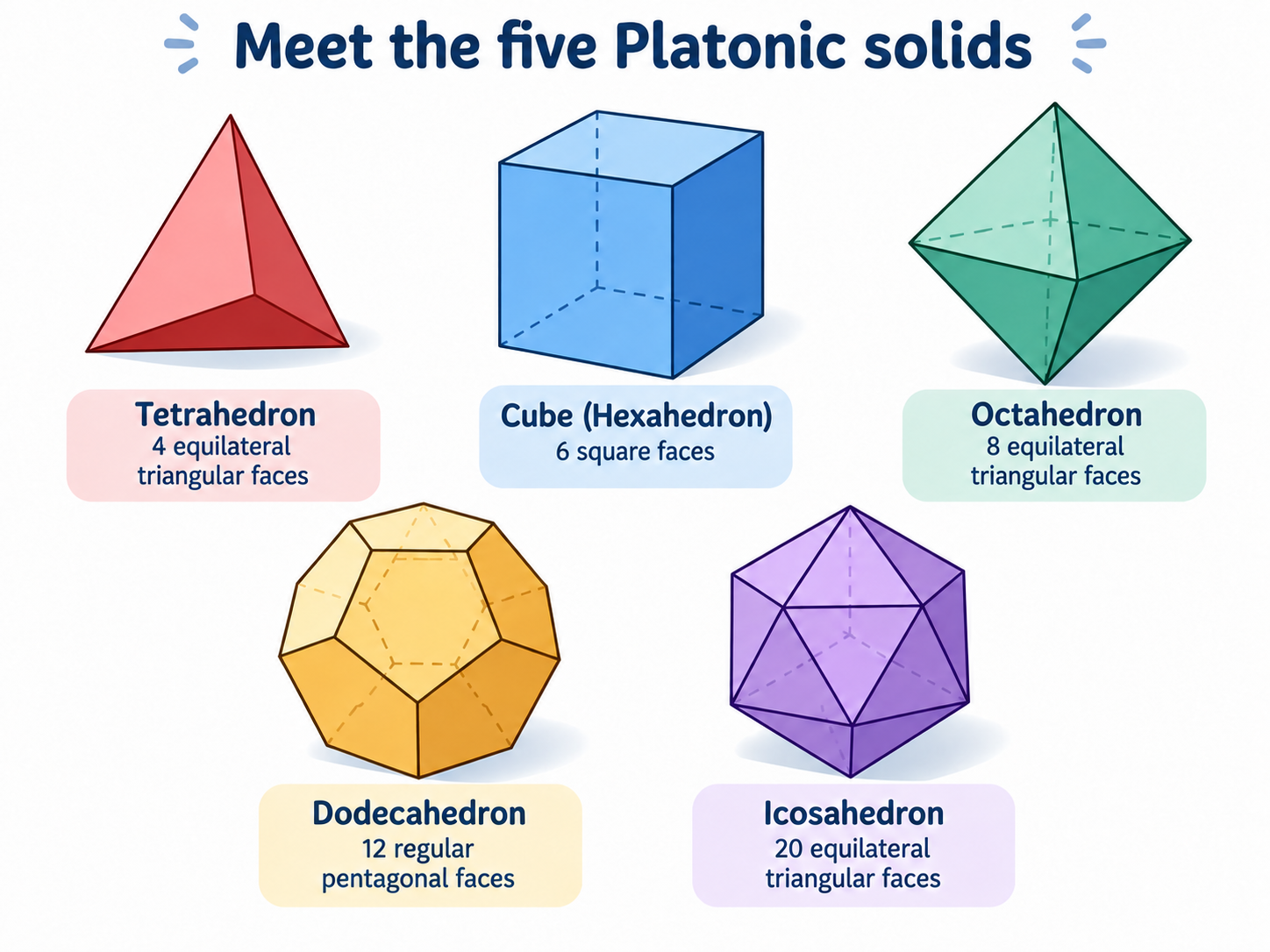
Why does the list stop after five? The answer comes from looking closely at what happens around a vertex.
3. Why are there only five?
To make a corner of a solid, the faces meeting there must bend around the vertex. If they fit completely flat, they do not make a three-dimensional corner at all.
Three, four or five triangles can meet and still bend into a corner. But six equilateral triangles around one point lie flat.
Three squares can bend into a corner. Four squares around one point make a flat arrangement.
Three pentagons can bend around a vertex. Add any more and there is not enough room.
Three regular hexagons already fit perfectly flat, so they cannot form a Platonic-solid corner.
Make a corner
Cut out several identical paper triangles, squares or pentagons. Tape them together along their edges so that they meet at one point.
How many can you join before the pieces lie flat or start overlapping?
4. Can solids fill space?
In Lesson 2, you asked which flat shapes can cover a floor with no gaps and no overlaps. We can ask the same question in three dimensions:
Cubes can. Stack cubes beside, above and behind one another and every bit of space is filled. This is the three-dimensional cousin of tiling a floor with squares.
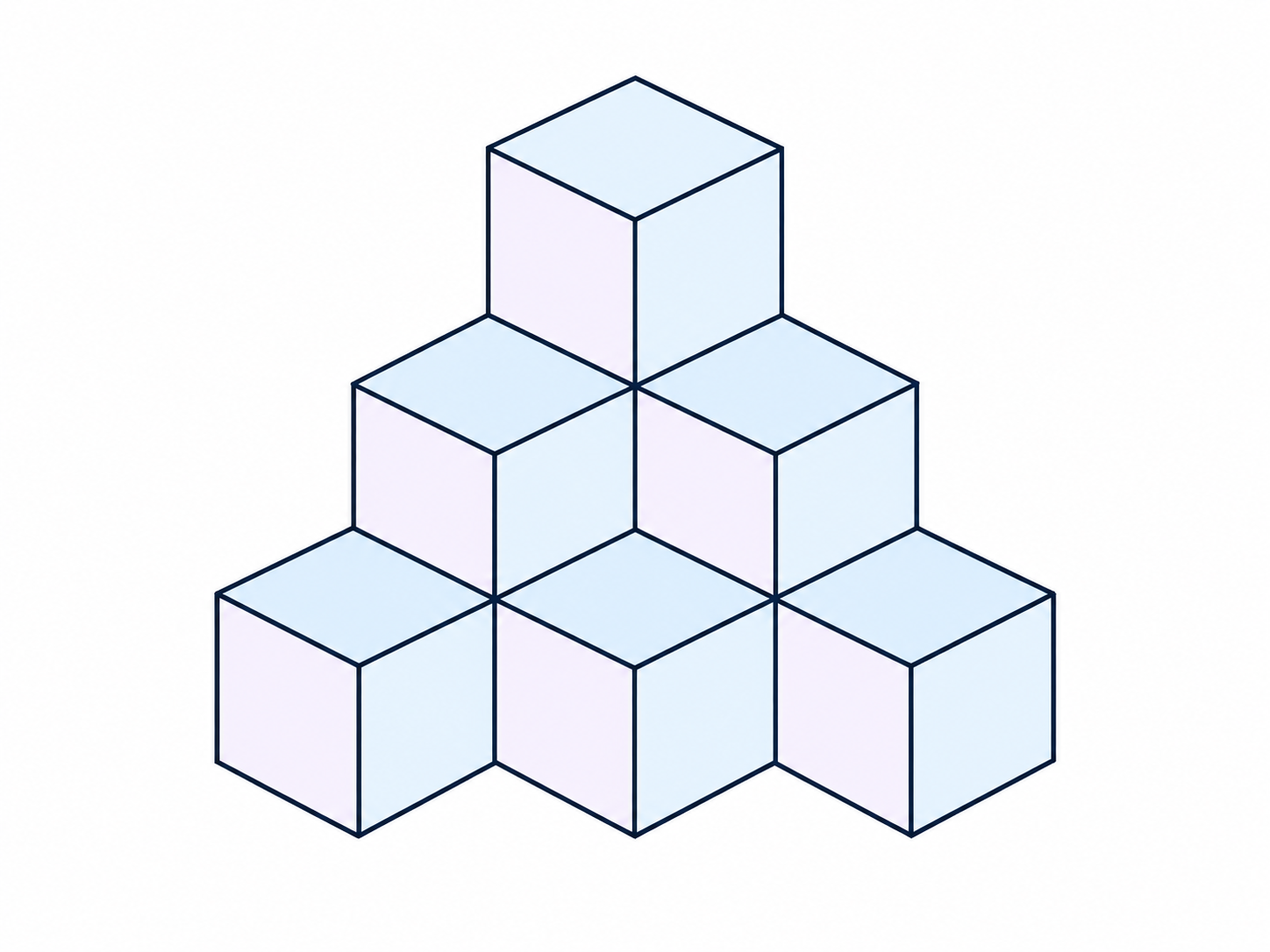
Most regular solids do not fill space by themselves. Even some beautifully symmetrical shapes leave awkward gaps when you try to pack copies together.
Which would you expect to pack more easily: cubes, tetrahedra or balls?
Do not worry about being right. Make a prediction, explain why, then keep reading.
5. Why do balls leave gaps?
Imagine filling a box with identical balls. Unlike cubes, curved balls cannot press flat against one another. Whenever several touch, small spaces remain between them.
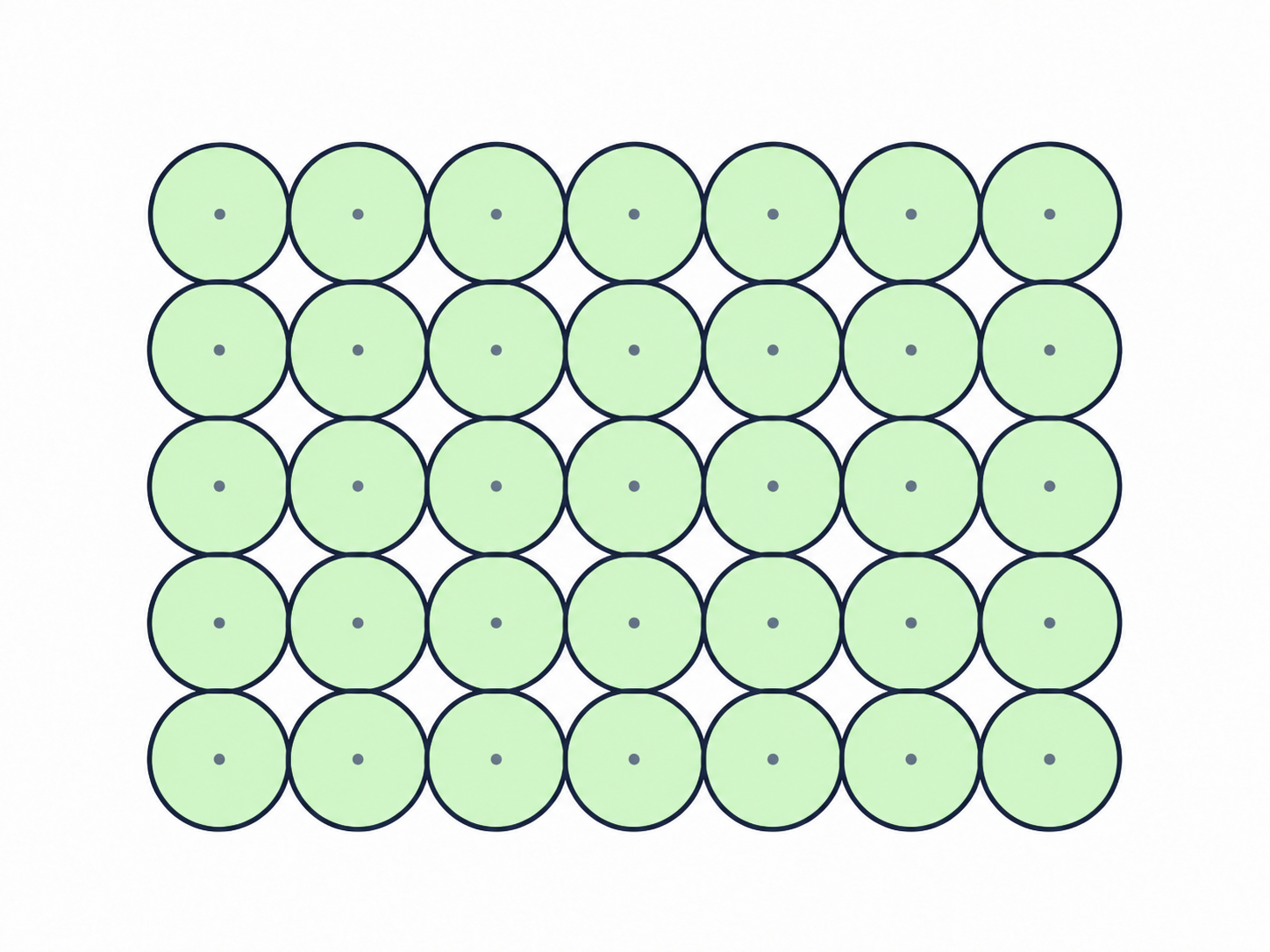
The gaps line up in straight channels.
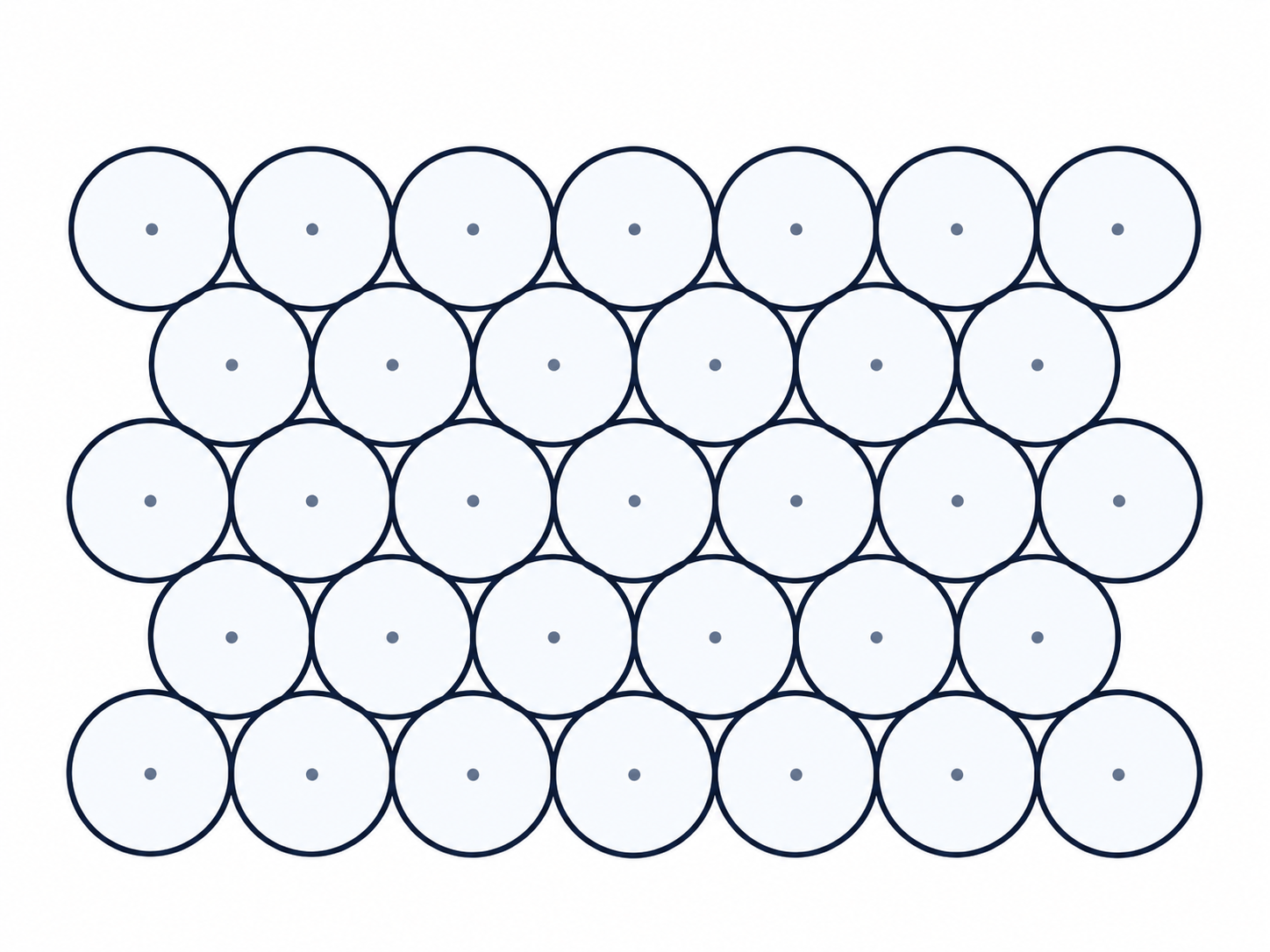
Each ball can sit partly in the hollow between two balls below it.
The second arrangement wastes less space. In three dimensions, the same idea leads to the familiar arrangement used for piles of oranges, cannonballs and closely packed atoms.
6. Packing challenge
Pack as tightly as you can
Use coins, counters, marbles, pom-poms or drawn circles. Make a rectangular boundary and try to fit as many equal circles inside it as possible.
Round 1: place them in neat rows.
Round 2: stagger the rows.
Round 3: invent another arrangement.
Which pattern fits the most? Where can you still see wasted space?
More than 400 years ago, Johannes Kepler proposed a way of packing equal spheres as tightly as possible. It looks like the way oranges are stacked in a market: each new ball sits in a hollow between balls below. Proving that no other arrangement can do better turned out to be extremely difficult.
What have you discovered?
Mirror lines become planes of symmetry, and rotations happen around axes.
There are exactly five completely regular convex solids.
Some solids, such as cubes, can fill space without gaps.
A repeating pattern can leave gaps, and changing the pattern can change how much space is wasted.
What happens in four dimensions?
We cannot see four-dimensional space directly, but mathematicians can still define higher-dimensional versions of cubes and regular solids. Patterns do not stop at three dimensions — our imagination does.
Lesson 6: Patterns in 3D
Download the combined handout and activities to explore three-dimensional patterns, solids and how shapes fit together in space.
Get the Lesson 6 resources →What did you think?
Whether you explored this together or worked independently, we would love to hear from both learners and parents. Tell us what you enjoyed, what was confusing, or what you would like to see next.
Share your feedback
The form is short and you do not need to give your name.